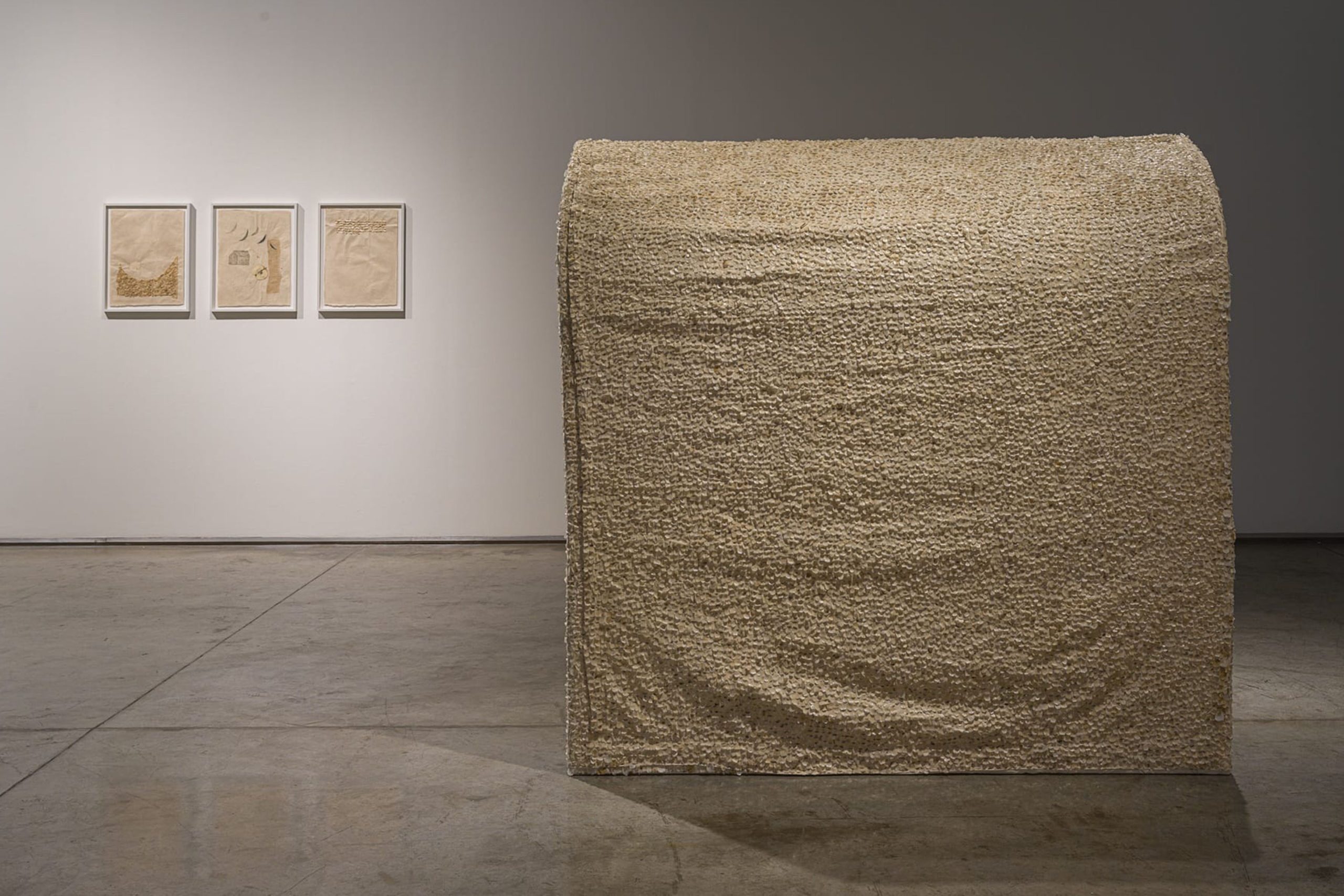
On 28 March 2026, a major solo exhibition of celebrated Algerian artist Rachid Koraïchi opens in the spaces of the Sharjah Art Foundation (SAF): Gallery 5 (Al Mureijah Square) and the Calligraphy Museum. The show spans more than 50 years of the artist’s creative practice and presents his fascination with signs, symbols, and Sufi philosophy through a series of multi-layered installations. Curated by art historian, critic, and curator Salah M. Hassan, the exhibition will run through 30 August 2026.
Between the Quran and the Avant-Garde: The Formation of an Artist
Rachid Koraïchi was born in 1947 in Ain Beida (eastern Algeria) into a family whose roots trace back to the Quraysh tribe of Mecca, from which the Prophet Muhammad descended. His ancestors were Quranists, scholars, and copyists: people for whom writing was a sacred act. Koraïchi spent his childhood in the atmosphere of the Sufi order, and this determined his subsequent creative trajectory.

He grew up during the period of Algeria’s independence in 1962: a time of national self-determination in which the question of cultural identity became particularly urgent. Koraïchi received his first education at the School of Fine Arts in Algiers and then continued his training at the School of Decorative Arts and the School of Fine Arts in Paris, making that characteristic transition between two cultural worlds that would become one of the key motifs of his work.
Koraïchi found a way to integrate the spiritual heritage of his family and the Western modernist tradition into a unified art practice. His art exists on the boundary between the sacred and the contemporary, between tradition and innovation, between East and West. It is precisely this liminality that makes his works so compelling.
Calligraphy as a Universal Language
The central element of Koraïchi’s practice is his work with signs and writing, yet it would be a mistake to reduce his art to calligraphy in the traditional sense. He works with writing as a visual and spiritual force, the energy of the sign, existing between the legible and the illegible, between communication and meditation.

In his art pieces, Arabic calligraphy coexists with glyphs from other linguistic systems, creating a visual palimpsest in which different writing traditions enter into dialogue. This approach is rooted in the Hurufiyya, an art movement pioneered by Iraqi artist Madiha Omar. It addresses the Arabic letter (hurf) as an aesthetic and spiritual object, drawing on Sufi esotericism.
For Koraïchi, writing is sacred and charged with meaning, but this meaning cannot be reduced to the specific content of a text. His signs function like talismans whose power lies in the act of their inscription. It makes his art simultaneously rooted in the Islamic spiritual tradition and consonant with the concerns of contemporary art, with its reflection on the nature of sign, representation, and meaning.
Materiality and Mastery: A Dialogue with the Artisan Tradition
A characteristic feature of Koraïchi’s practice is the diversity of materials and techniques he employs. Ceramics, textiles, bronze sculptures, steel constructions, alabaster, marble, printmaking, and painting — each material is a field of experimentation and a form of homage to the artisan tradition. Koraïchi involves local masters and craftspeople, trained in ancient traditions, in the creation of components for his installations: objects saturated with metaphor, multi-layered in both figurative and processual terms.

This way, Koraïchi creates a link between past and present, between the anonymous mastery of generations and individual authorial vision. His routes of collaboration often retrace the paths by which his ancestors reached Algeria, transforming the geography of family history into a map of art practice.
Sufism as an Artistic Method
The Sufi tradition is a structural principle of Koraïchi’s work. Sufi mysticism, with its emphasis on inner experience, repetition (dhikr), and the dissolution of boundaries between subject and object, between the knower and the known — all this finds direct expression in Koraïchi’s practice. Many of his installations are meditative spaces in which the viewer is invited not to rational analysis but to direct sensory experience.
Sufi talismans and magic squares (objects in which writing is endowed with protective and transformative power) constantly inspire Koraïchi. He turns them into a contemporary artistic language while preserving the energy of the sacred that is inherent in the originals. It makes his works accessible to viewers from diverse cultural contexts. To feel the power of his works, an openness to visual and spiritual experience is sufficient.

International Recognition and Significance
Rachid Koraïchi has participated in many exhibitions and major art events, including the 47th and 49th editions of the Venice Biennale; Without Boundary: Seventeen Ways of Looking (the Museum of Modern Art (MoMA), New York, USA, 2006); and Word into Art (the British Museum, London, UK, 2006), among others. His art pieces were part of Seeing Through Light: Selections from the Guggenheim Abu Dhabi Collection, the pre-opening exhibition of Guggenheim Abu Dhabi, which opened in November 2014 at Manarat Al Saadiyat. Koraïchi’s accolades include receiving the Jameel Prize (2011) and having his project Le Jardin d’Afrique shortlisted for the Aga Khan Award for Architecture (2022).
Today, the artist resides in Paris, yet his projects are realised in Algeria, Egypt, Spain, Tunisia, the USA, and Dagestan. Each new project becomes an occasion for dialogue with local artisan traditions and cultural contexts.

The Exhibition in Sharjah: Five Decades in Two Spaces
The exhibition at the SAF promises to be one of the most comprehensive presentations of Koraïchi’s work. Its placement across two spaces (Gallery 5 and the Calligraphy Museum) underscores the dual nature of his practice. On one hand, it is contemporary art requiring an appropriate exhibition context; on the other, it is a direct continuation of the calligraphic tradition, for which the Calligraphy Museum is a natural habitat.
The choice of Salah M. Hassan as curator is a strategic decision. He is among the leading specialists in African art and the African diaspora, founder of the journal Nka, and a professor at Cornell University. Hassan possesses the ability to place works by non-European artists within a broad historical and cultural field, avoiding both exoticisation and reductive universalism.

Koraïchi in the Context of Arab Visual Culture
Rachid Koraïchi’s exhibition in Sharjah is particularly significant in the context of a discussion about the place of Arabic calligraphy and visual culture in contemporary art. For decades, the Western art world has regarded calligraphy as a craft devoid of the intellectual depth of contemporary art or as an exotic element of an “other” culture. Koraïchi, alongside such artists as Ibrahim El-Salahi, Ahmed Moustafa, and Shirin Neshat, belongs to those who have expanded the understanding of what calligraphy can be in the context of contemporary art practice.
His works demonstrate that engagement with tradition does not mean retrograde thinking and that rootedness in a specific spiritual tradition does not preclude universal resonance. This message is especially important for the Middle East region, where finding a balance between preserving cultural heritage and participating in the global artistic process remains one of the key challenges in cultural policy.
You can learn more about Rachid Koraïchi’s exhibition on the SAF’s official website.
You might also be interested in visiting Cultural Landscapes of Al-Andalus and Of Land and Water: Works from SAF Collection.