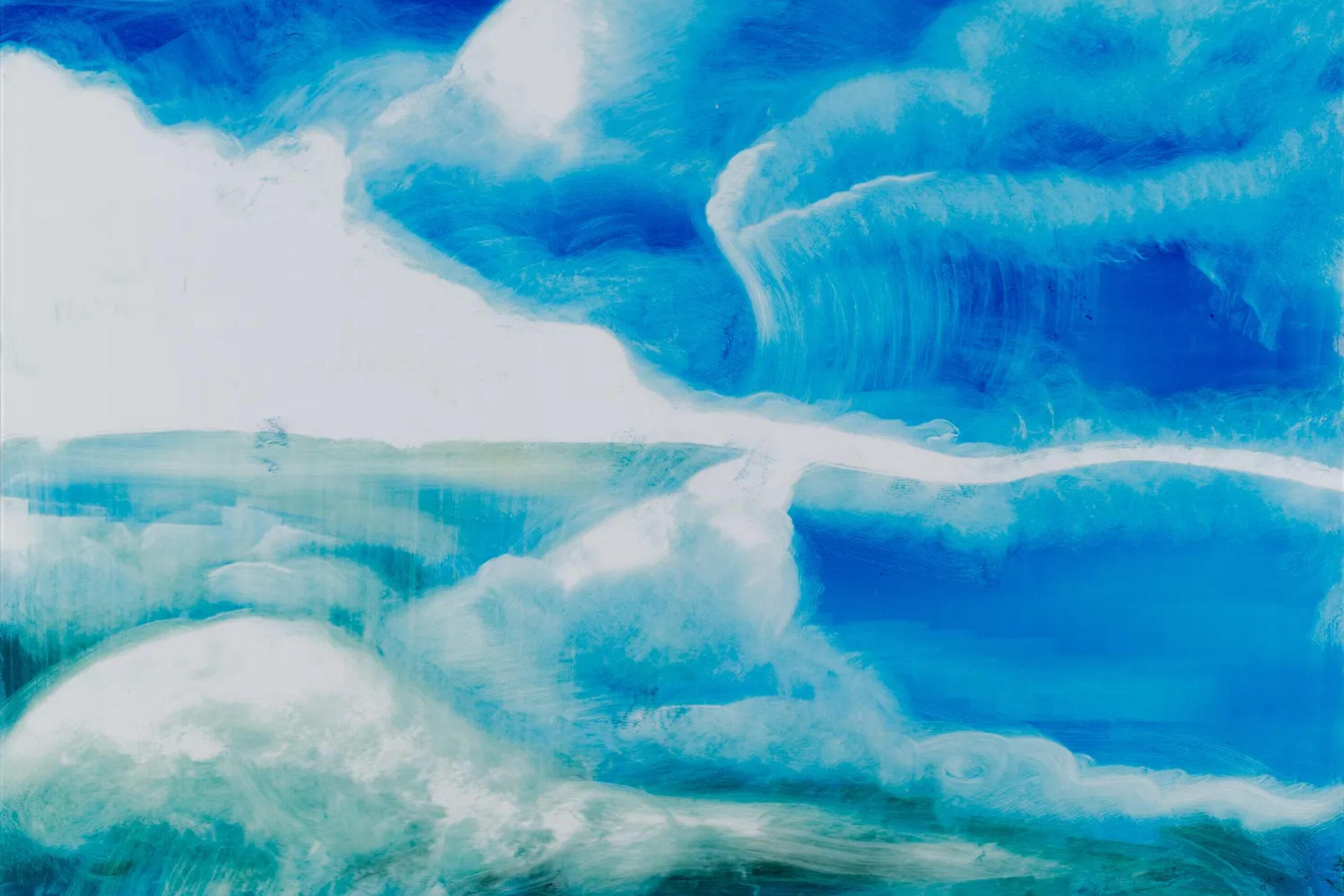
On view at Gallery Isabelle until 4 November 2026, A Momentum for the Horizon features a series of reverse glass paintings by Lebanese artist Alaa Itani. The show examines the horizon as a physical boundary and an elusive promise, exploring how landscapes can hold memories of places and moments no longer accessible.
Rather than treating landscape as a stable view of the natural world, Itani approaches it as a space shaped by time, recollection, and the act of looking. The resulting works invite viewers to consider the distance between what they see and what they remember, as well as how images of places can change as they move between experience, memory, and artistic interpretation.
The horizon marks the meeting point between earth and sky, yet remains out of reach. It gives a landscape structure and direction, offering the eye a point of orientation, but it also represents a limit that cannot be crossed by moving towards it. In A Momentum for the Horizon, this tension becomes a way of thinking about time and displacement. In the displayed paintings, blurred contours and atmospheric formations make the scenery feel unstable, as though it were emerging from a recollection or dissolving before the viewer. The horizon becomes a threshold between different states of perception.

The artworks encourage viewers to look beyond the immediate appearance of the paintings and consider the relationship between a place and the time associated with it. A landscape can evoke somewhere familiar without reproducing it precisely; it can also suggest a place remembered, imagined, or encountered indirectly through another artist’s work.
A distinctive feature of Itani’s practice is his use of reverse glass painting. He applies ink on glass and selectively wipes or erases portions of the surface. Light passes through the cleared areas, creating shadows and doubling parts of the painted image. Glass is simultaneously a surface and a transparent barrier: it allows vision while also separating the viewer from what lies beyond. The image formed on its reverse side introduces another layer of mediation: the landscape appears as something encountered indirectly rather than just observed.
Erasure is as significant as applying ink. Instead of constructing an image only through the addition of marks, Itani also develops it by removing material. The resulting interplay between presence and absence echoes how memories are formed and revised. Certain details remain visible, while others become indistinct or disappear altogether.

Light further complicates the experience. Because it passes through the cleared areas, the work is not entirely contained within its painted surface. Shadows and visual doubling add a dimension. The landscape becomes an encounter between material, illumination, and perception rather than a fixed representation.
Itani’s research into the history of Arab modernist painting provides another important context for the exhibition. In particular, A Momentum for the Horizon is inspired by the work of Lebanese artist Rafic Charaf (1932–2003), who painted landscapes of the Bekaa Valley from memory in his Beirut studio. His practice parallels Itani’s interest in the relationship between landscape, recollection, and distance.
This connection points to the possibility of representing a landscape without direct access to it, allowing memory and artistic interpretation to shape the resulting image. In Charaf’s case, the landscapes of the Bekaa were recalled away from the places themselves. Itani takes up a related question through a different medium, using the transparency of glass, blurred imagery, and erasure to explore how landscapes persist in the mind.
His approach also draws attention to the act of looking as a process unfolding over time. A landscape recalled from memory is never identical to the original experience; each return involves selection, reconstruction, and change. Similarly, the viewer of Itani’s paintings must negotiate between what is immediately visible and what remains indistinct.

About the artist
Alaa Itani (b. 1996) is a Beirut-based artist, researcher, and archivist who earned a BA in Communication Arts from the American University of Science and Technology (Beirut, 2019) and a BFA in Plastic Arts from the Lebanese University (2022). His work, which encompasses painting, drawing, and printmaking, engages with questions of representation, memory, and the ways visual narratives shape our understanding of places and histories. Itani’s background in theatre also informs his practice. He is interested in staging, constructed environments, and the historical imagery through which cultures and identities are represented.
Itani’s research and archival practice are also an important part of his art. Through engaging with historical images, he examines how representations circulate, acquire meaning, and influence contemporary perspectives. His earlier projects have addressed historical tensions between East and West and the impact of neo-Orientalist narratives on perceptions of Arab and Islamic societies.
Itani’s work has appeared in exhibitions such as Beyond the Lines: Drawing in Space (the Boghossian Foundation, Villa Empain, Brussels, Belgium, 2024) and Impressions from an Archive, Exhibition Research Lab (Liverpool Arab Arts Festival, UK, 2022), among others. His recent accolades include residencies at Hospitalfield, Scotland (2025) and Villa Empain, Brussels (2024). Itani also received the Boghossian Foundation Prize Lebanon for visual arts (2022) and a Beirut Printmaking Studio scholarship (2021). He also participated in the British Council Lebanon’s CATAPULT.visual’arts programme.
You can learn more about A Momentum for the Horizon on the exhibition’s official web page.
In addition, you might be interested in visiting Al Nayed by Abdulqader Al Rais.


