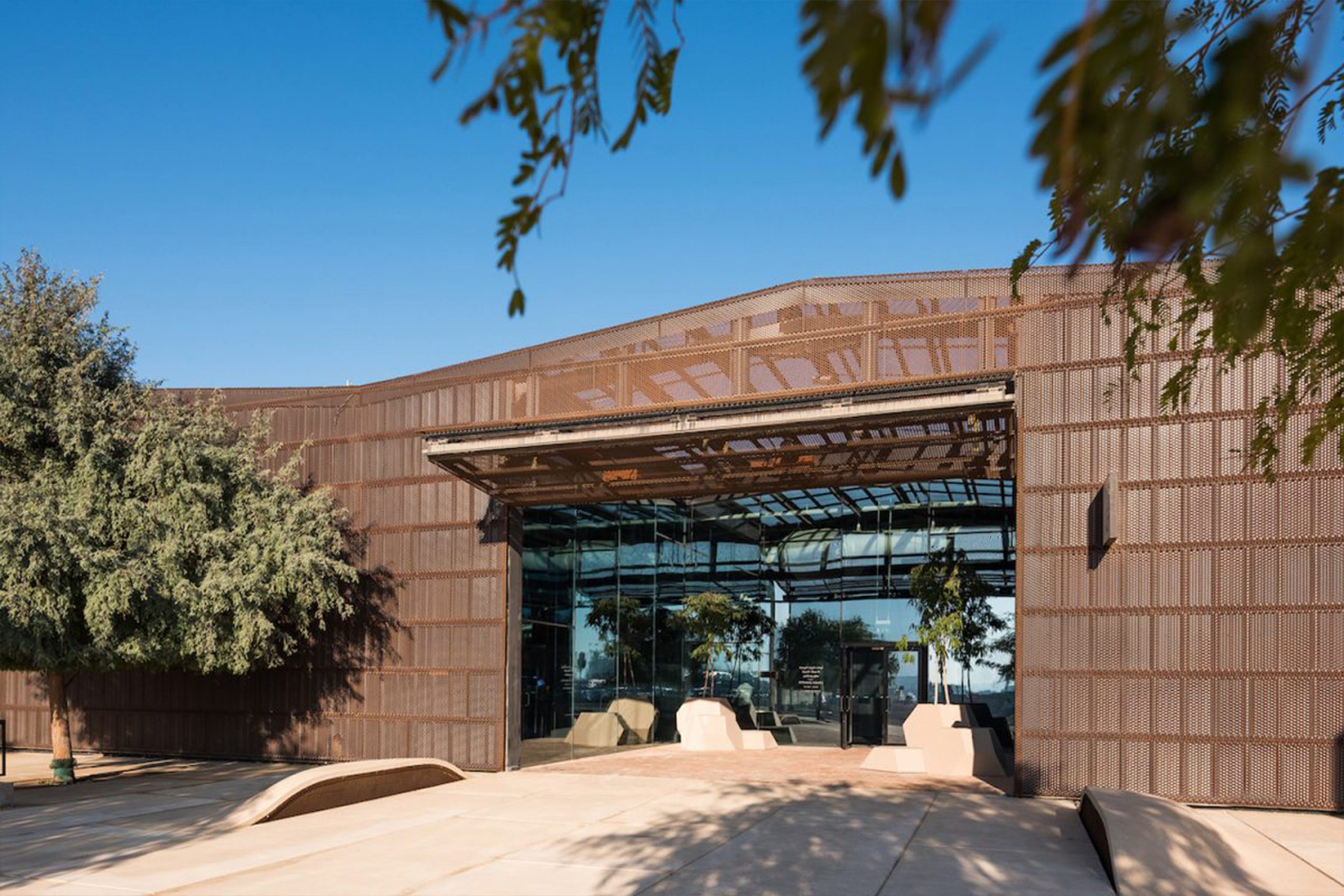
“Time the destroyer is time the preserver” is an extensive solo exhibition by Chilean artist Jorge Tacla, on view in Galleries 1, 2, and 3 at Al Mureijah Square in Sharjah. The title, borrowed from a poem by T.S. Eliot, formulates the central paradox of Tacla’s work: destruction and preservation are two sides of a single process, and art is capable of holding both forces simultaneously. The exhibition will remain open until 21 June 2026.
From Santiago to New York: The Artist’s Path
Jorge Tacla’s (b. 1958, Santiago, Chile) family has Palestinian and Syrian roots. This multicultural heritage became one of the key factors shaping his artistic worldview: a sensitivity to questions of memory, identity, and belonging.
Having trained at the School of Fine Arts of the University of Chile (Santiago), Tacla moved to New York in 1981, where he resides to this day, regularly returning to Chile. Since then, his work has unfolded between two hemispheres (geographic and cultural), and his practice is based on this duality.
The Method of “Recording in Negative”
Tacla’s artistic method took shape in the late 1980s during his travels in Chile’s Atacama Desert. Tacla paints a building or landscape “in negative,” leaving the object defined by the absence of colour. In this sense, his paintings portray how consciousness perceives an image, allowing us to discern how events inscribe themselves into individual and collective awareness.

Working with the “negative” is a renunciation of the physicality of matter. The images Tacla creates fix the essence of the living, what remains after the visible has vanished. The Atacama Desert, apparently empty, yet populated by memory, became the laboratory for this method.
Tacla’s “negative” is a way of seeing in which architectural forms, landscapes, and spaces reveal structural systems that under normal conditions remain invisible. Architecture in his works becomes a stand-in for the human body: when a building is transformed, time accelerates, stripping away the skin of the façade and exposing the skeleton, the internal structure.
Eight Chapters: The Structure of the Exhibition
The exhibition is organised in eight chapters. This structure reflects the artist’s working method: he maintains several series simultaneously, each with its own unique style and language.
The first chapter, Body and Expression, presents figurative works from the 1980s, created during a period when the artist lived in New York’s East Village. Drawing on Francis Bacon’s paintings, works such as “Untitled” (1985) and “December” (1988) reflect the atmosphere of the city at that time and the advent of the 24-hour news cycle, which transformed the perception of visual information.

The second chapter, Remembering the Desert, develops the theme of landscape through works created after the artist’s journeys to the Atacama Desert. “Logical Product No. 2” (1992) and “Paradise” (1994) incorporate what the artist calls “remnants of the living”: elements disrupting the conventional perception of desert spaces as “empty.”
The third chapter, Architectural Structures, turns to architecture as a recurring motif through which Tacla explores forms of spatial organisation. “Distribution of the Primes” (1995) offers an aerial view of large architectural complexes, while “Nitrogen Cycle” (1996) isolates specific buildings, allowing the viewer to perceive them as abstract forms.
The theme of the fourth chapter, Report of Injuries, is loss and documentation. The installation “Informe de Lesiones” (2016–2019) comprises framed fragments of damaged documents. The artist also committed to fire some of his notebook drawings, which symbolises the fragility of creative legacy and the vulnerability of cultural memory.

The fifth chapter, Anatomy of Dyslexia, and the sixth, Scenes of Collective Action, focus on forms of collective participation and social dynamics. Works from the series “Señal de Abandono” (1999–ongoing) spotlight moments of human solidarity and collective experience.
The seventh chapter, Hidden Identities, presents Tacla’s series of paintings, in which he works with imagery indirectly, replacing human bodies with architecture, furniture, and technology. This creates emotional distance while intensifying the impact of the image.
The final chapter, Ruins, concludes the exhibition with a visual field that connects images of architectural transformations from different parts of the world. Tacla juxtaposes the traces of time on buildings with the consequences of natural forces, meditating on the fragility of material forms. Also on display here are compositions that recall microscopic analyses of internal structures.
Multicultural Identity and the Artistic Context
“Time the destroyer is time the preserver” acquires a special dimension thanks to its geographic and cultural context. Having Palestinian and Syrian roots, the artist has a multi-layered connection to the region in which his works are now being shown. His heritage enriches the perception of his art.

Of Chile, Tacla says: “Chile is always present in everything I do. It is the land my family emigrated to from Syria and Palestine. That is ground zero for my own identity […].” This formulation precisely describes the position of an artist whose practice unfolds within a field of multiple belongings.
Tacla’s work resonates with themes that are central to the Middle East: the contemplation of space, the investigation of architectural forms, and engagement with memory through visual language. His method (capturing the traces of time on the built environment) is consonant with the region’s attention to cultural heritage preservation.
The Art of Witnessing: Tacla’s Visual Method
One of the key themes of the exhibition is the question of representation and visual perception in an era of image saturation. In a visual culture where machine vision and satellite imagery play an ever-greater role, Tacla’s painting restores central importance to individual perception and memory. Tacla does not document events directly; he creates images of how reality is perceived, remembered, and processed by consciousness.

Curatorial Vision and the Exhibition’s Significance
The exhibition is curated by Hoor Al Qasimi (President and Director of the Sharjah Art Foundation) together with Abdulla Aljanahi (Curatorial Assistant). The eight-chapter structure allows for the construction of a dialogue between artworks from different decades, revealing unforeseen connections and resonances.
More than 170 art pieces, including 70+ paintings and 100+ works on paper from the mid-1980s onward, make this the largest solo presentation of Tacla’s work in his career. For an artist whose works have been exhibited at biennales and in museums around the world, the Sharjah retrospective represents recognition at a new level and is simultaneously a landmark event in a region connected to his family history.
You can learn more about “Time the destroyer is time the preserver” on the exhibition’s official web page.
In addition, you might be interested in exploring Urdu Worlds: Where Language Becomes Home and visiting the House of Arts at Expo City Dubai.