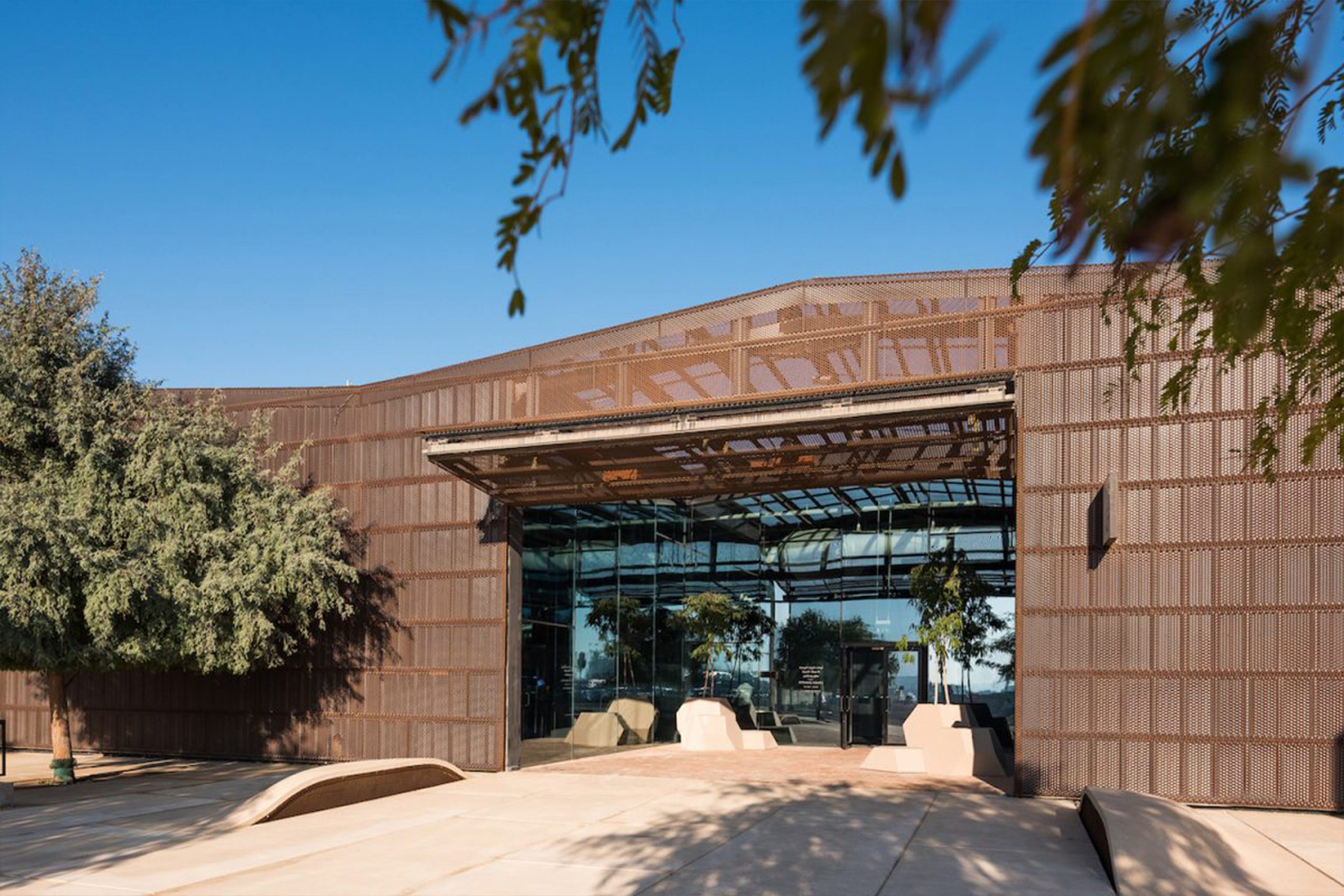
When World Expo 2020 closed its gates, most pavilions were dismantled or remained as silent monuments to a six-month celebration. The Morocco Pavilion, seven storeys of rammed earth, built from soil collected within three miles of the site, its façade pierced by thousands of slatted wooden screens, was conceived differently from the start. In November 2025, the building opened for the second time as House of Arts, a permanent venue for artists from the UAE and the wider Gulf.
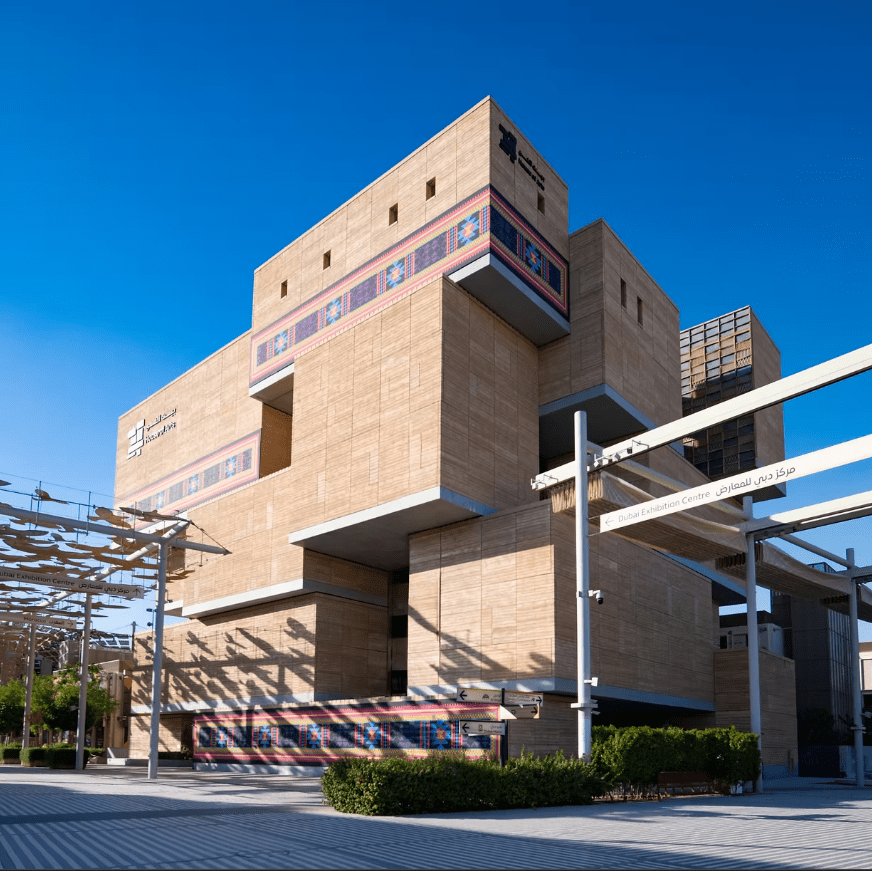
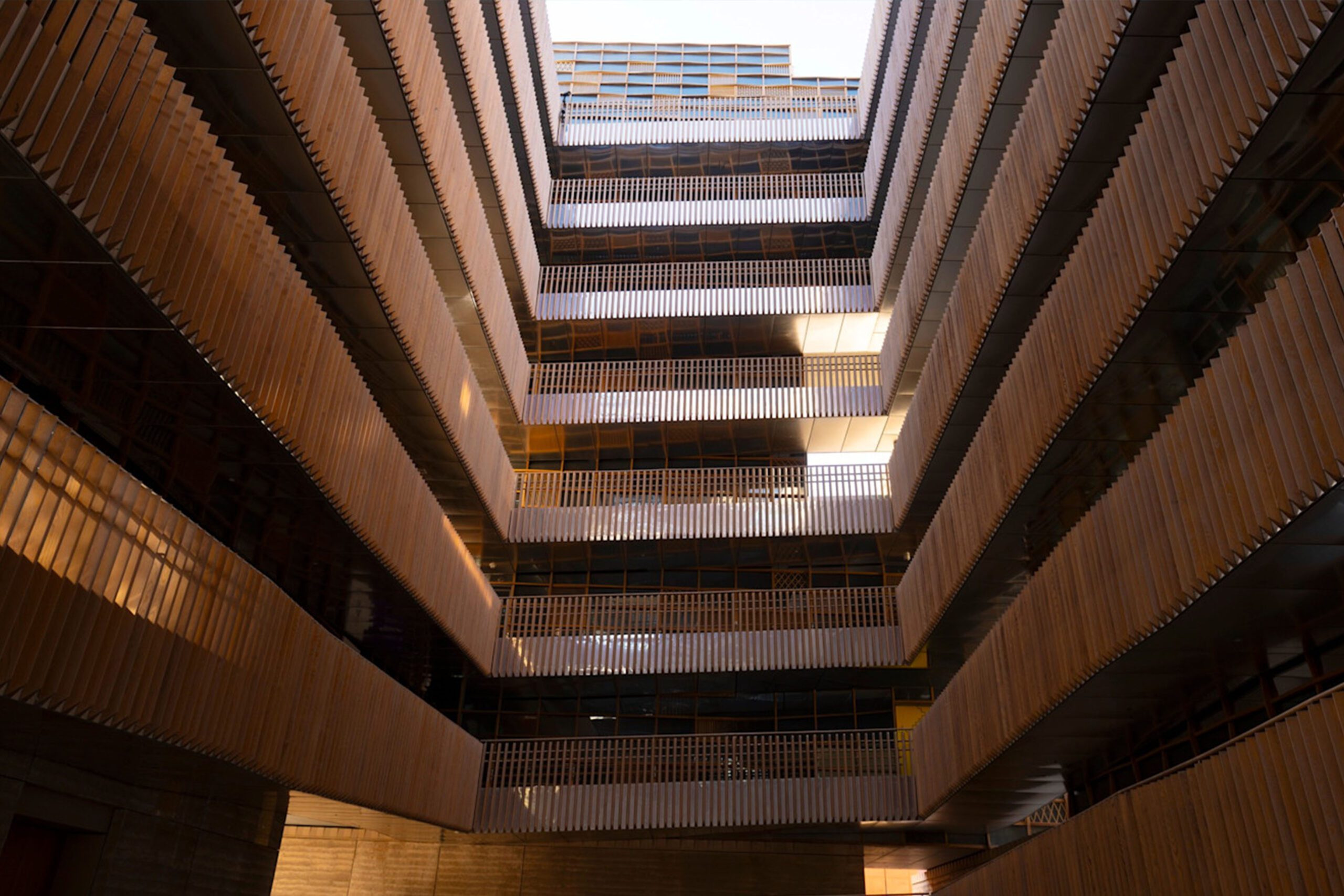
The pavilion was designed by the Paris- and Casablanca-based studio OUALALOU + CHOI, led by Tarik Oualalou and Linna Choi, with the rammed-earth engineering developed by the Earth Structures Group of Rick Lindsay. The façade rises to 34 metres — among the tallest of its kind ever built. Rammed earth (in Arabic, tabia; in French, pisé) is one of the oldest building techniques, used for centuries across the Maghreb and the Arabian Peninsula to construct ksour, kasbahs, and the fortified earthen houses of the Drâa and Liwa valleys. Layer by layer, moist soil is compacted inside formwork until it gains the load-bearing density of stone; the finished wall preserves the horizontal joints of the process and the pigment of the original ground. Oualalou described the project as a stacked village: twenty-two cubic volumes assembled around a central courtyard and connected by an interior ramp, a contemporary reading of the slow, winding ascent of a Moroccan medina.
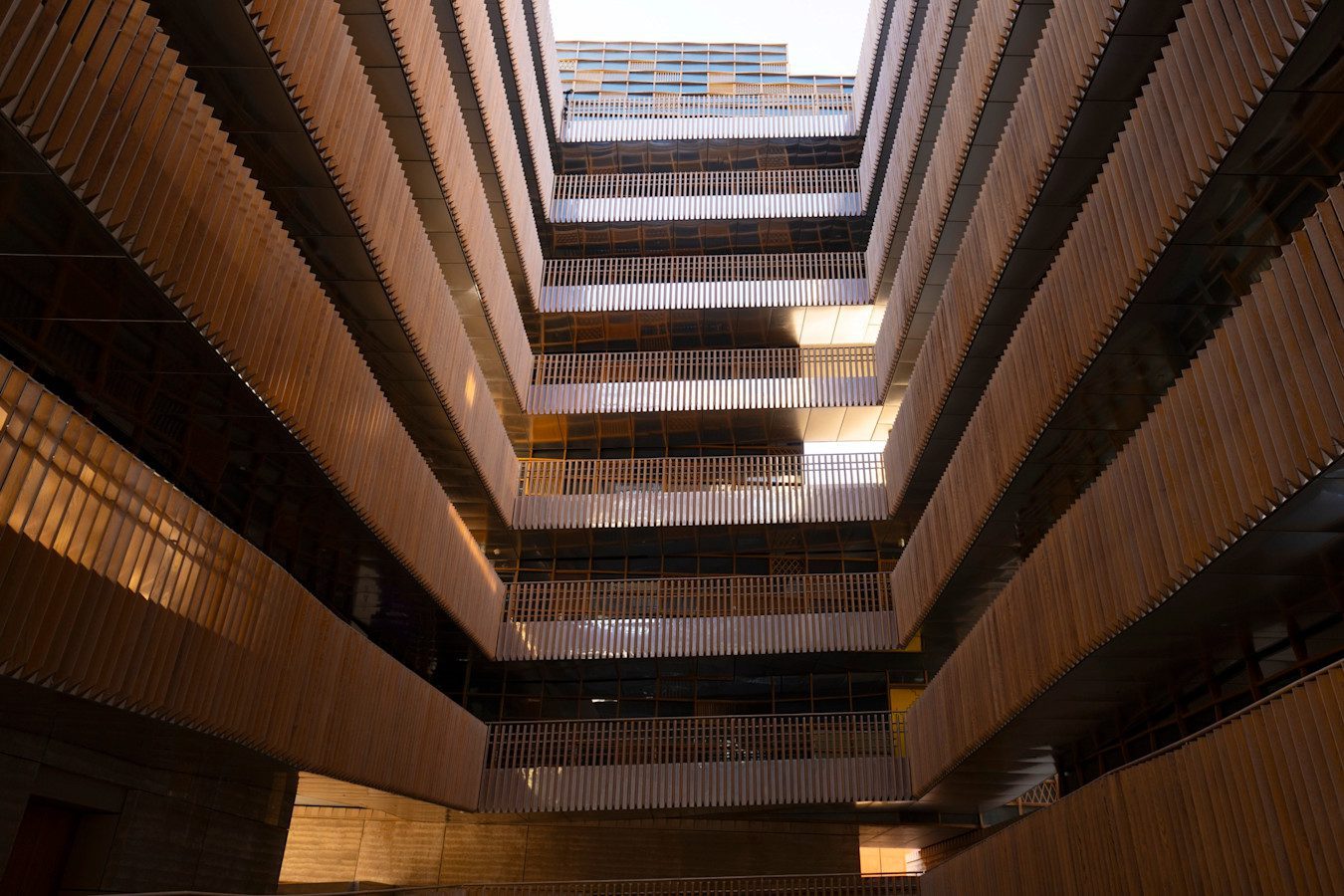
The structural solution is hybrid. The load-bearing frame is reinforced concrete; the earthen elements were manufactured as prefabricated panels fifteen centimetres thick, then hung from the frame as a cladding skin. This move translates a craft technique into an industrial format: it permitted the height, kept the geometry precise, and stabilised the mass of earth in a climate with daily swings of up to 45 °C. The gaps between the stacked volumes draw air through the building; ten hanging gardens act as thermal buffers; the wooden inner façades, alternating opaque and shaded glass, filter the sun in the manner of contemporary mashrabiya. The central courtyard is the principal climatic instrument: rising through every floor, it generates a vertical column of air that allows mechanical cooling to be kept to a minimum. The combination of heavy mass and softly modulated light produces a spatial atmosphere noticeably distinct from the conventional exhibition interior.
What sets this pavilion apart from most Expo national pavilions is that a second life was anticipated in the original brief. At the design stage, OUALALOU + CHOI worked with window openings prepared for residential conversion, closed during the Expo with smaller removable earthen panels. After the Expo, the project was adapted for a cultural function: the internal arrangement — twenty-two cubes linked by a ramp — proved suitable for a sequential exhibition route.
House of Arts comprises fourteen galleries, a café, a cinema area, and an educational wing. The director is Amna Abulhoul, executive creative director of Expo City Dubai.
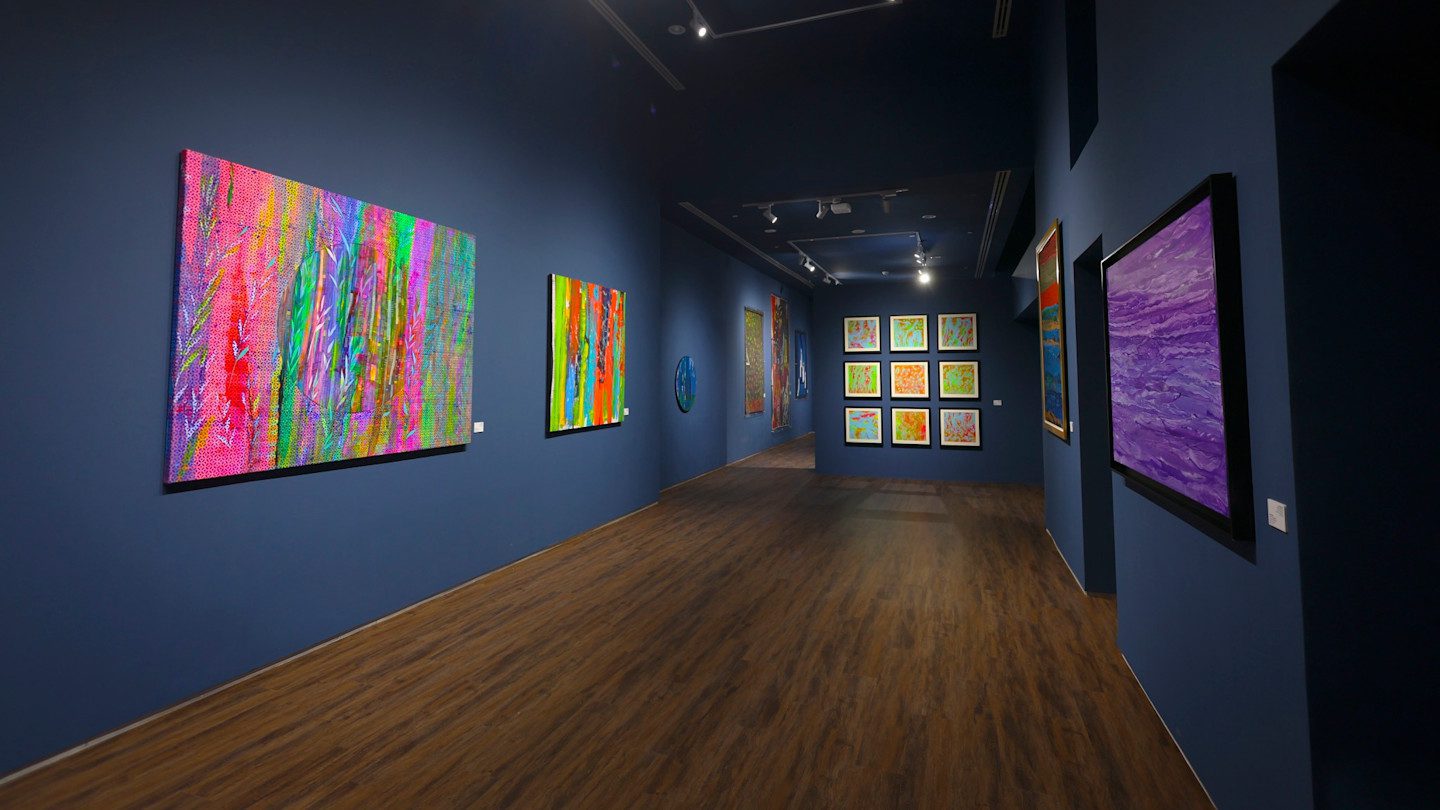
The inaugural exhibition, Interwoven, is organised around sadu, the geometric weaving practice of the Bedouin women of the Arabian Peninsula, inscribed in 2011 on UNESCO’s Representative List of the Intangible Cultural Heritage of Humanity. Sadu is built by hand in interlocking lines that accumulate into a pattern; it has historically marked tribal identity, partitioned tents, and carried the geometry of the desert into the domestic interior. Here, sadu is treated not as an ethnographic object but as a method: twenty artists from the Gulf and the wider Arab world work with the idea of interweaving in materials and media far removed from thread.
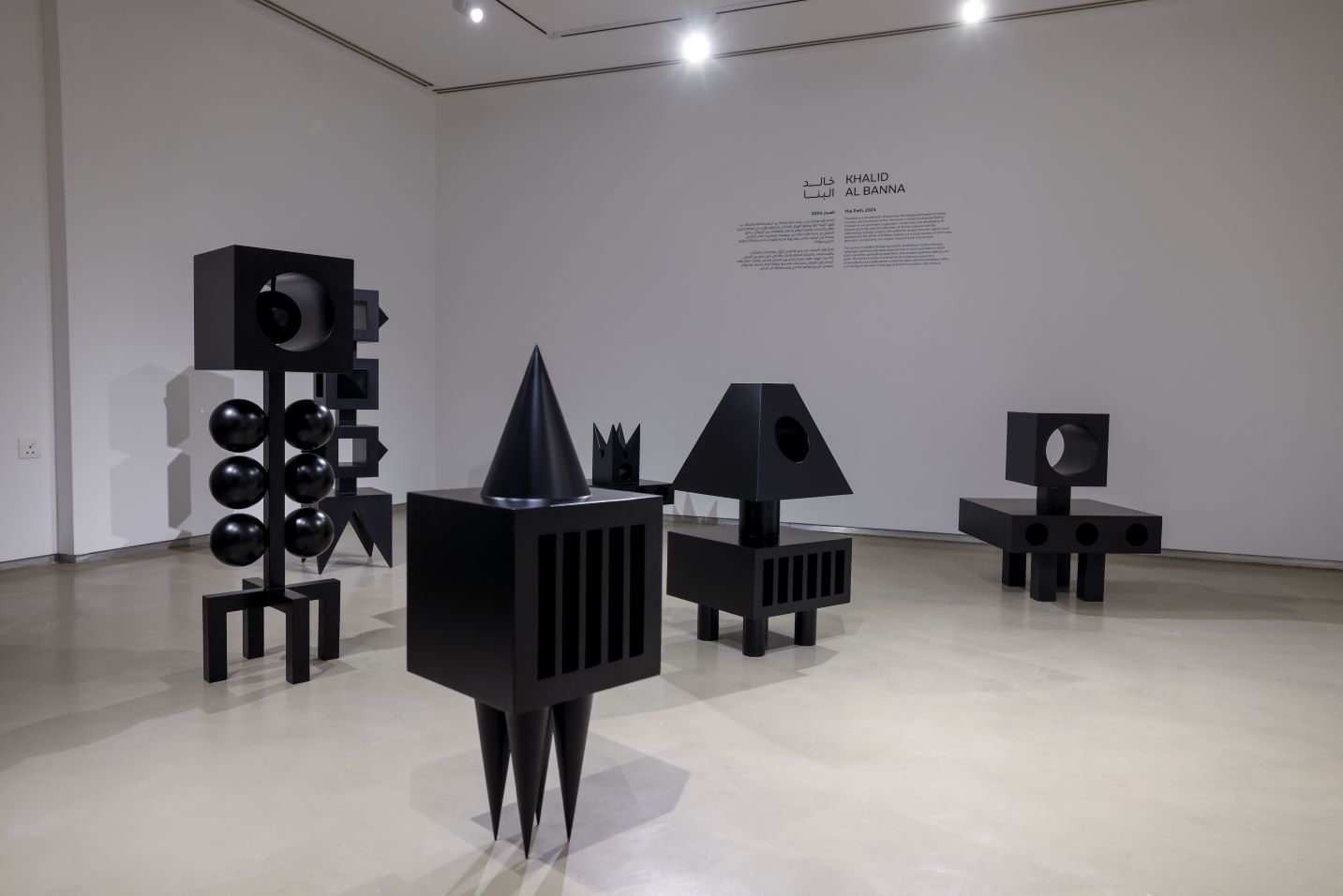
Najat Makki, one of the first women in the UAE to receive formal academic training in fine art, anchors the final gallery with a series of paintings in which the geometry of sadu is transposed into the layering of pigment. Khalid Al Banna returns to motifs from earlier murals and reimagines them as monumental sculptural forms, animated by internal light.
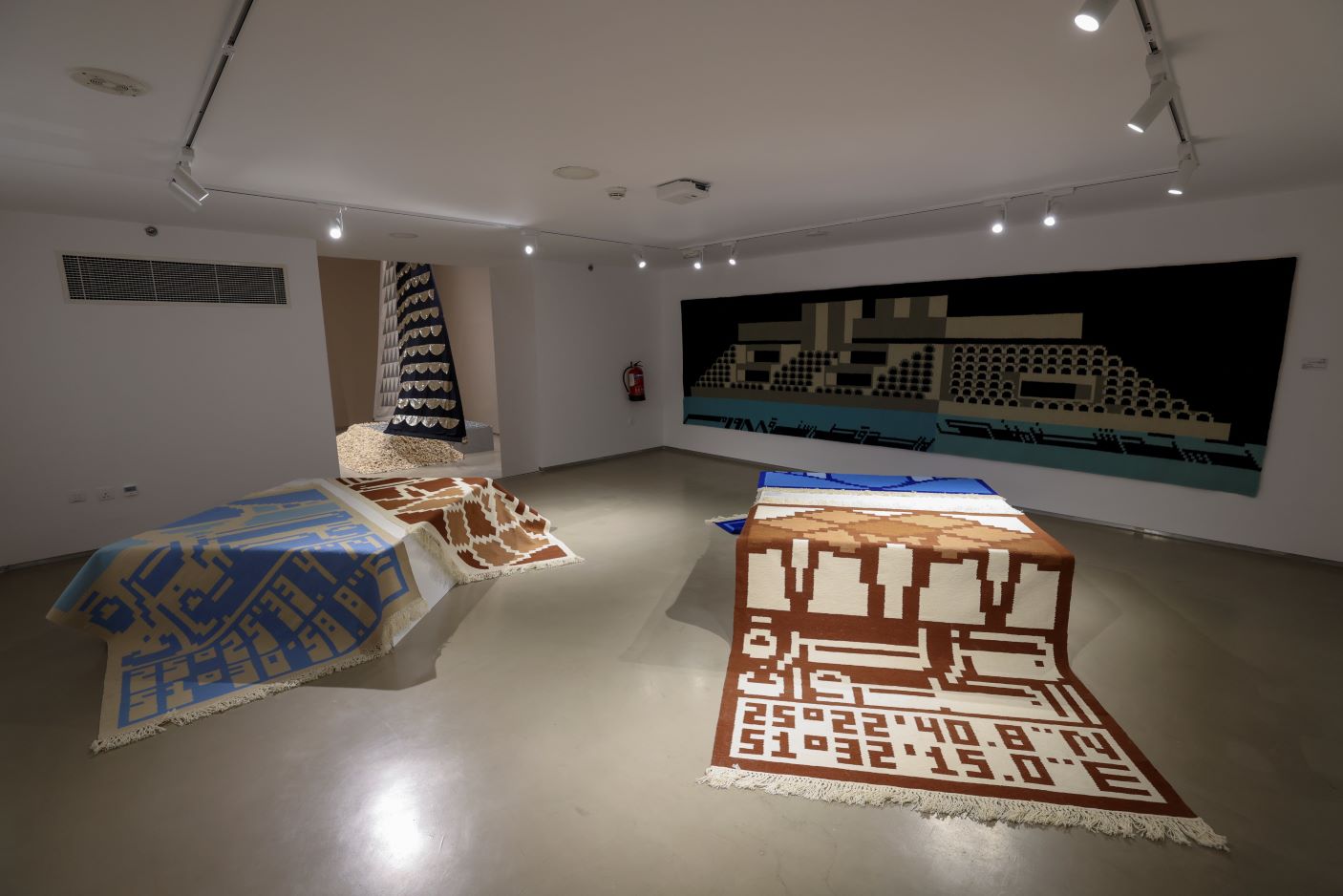
Noura Alserkal’s Magic Carpet 2.0 is woven not in thread but in ground coffee, cardamom, saffron, lavender, myrrh and her mother’s dukhoon — a textile of scent in which memory functions as warp and weft. Maryam Al-Homaid, from Qatar, uses the language of the loom for a pixelated cartography of her country’s artificial islands; her El Gewan Island records the land before it disappears. Sarah Al-Aulaqi, from Oman, suspends traditional Omani trousers embroidered in gold and silver thread, garments once hidden beneath an outer robe.
Ghada Khunji’s installation is positioned for a double encounter: visitors first see it from above as an unreadable form, then meet it again at eye level, one floor below. The decision reads as a response to the architecture itself — a building where the ramp asks one to walk rather than ride between floors. A dialogue between the photographer Ahmed Yousef Lootah, who documented Dubai in the years before it became Dubai, and his granddaughter Al Zaina, who designed the room in which his images are shown, closes a circuit of transmission: how an image, a document, and an interior pass through a single family gesture.
A group section, Still, Stirred and Shared, curated by Dirwaza Curatorial Lab, brings together five artists working through personal and collective histories of the Gulf, including Shaikha Al Ketbi, whose video of faceless figures crossing empty playgrounds and courtyards holds one of the exhibition’s quietest registers.
The programme around the exhibition includes concerts by Firdaus, the all-female orchestra founded under the patronage of Sheikha Manal bint Mohammed bin Rashid Al Maktoum; a cinema series in collaboration with Cinema Akil; and Saturday workshops for children aged four to twelve, built around tours of Khalid Al Banna’s work. The events calendar is updated on the venue’s website.
House of Arts is open to the public; entry is free. Interwoven runs until November — long enough to walk through all seven floors unhurriedly, at the pace the ramp itself sets. To get more information, please visit the official website of the House.
You might also be interested in viewing Fellow Travellers at Tabari Artspace and From the Perspective of Language by Sara Naim.