
The Last Century: 100 Years of Arab Art (1920–2020), an extensive exhibition at Khawla Art & Culture, presents an overview of artistic production across the Arab world over the past century. Curated by Jihad Mikhael, the show features a distinguished selection of works by 40+ artists, tracing the evolution of Arab visual expression, and will run through 8 January 2026.
Spanning multiple generations, geographies, and art movements, the exhibition explores how artists have continually reimagined cultural identity, social transformation, and aesthetic innovation in response to periods of profound historical change. The selected works chart key artistic developments, from early experiments with modernism and the reinterpretation of local traditions to later explorations of abstraction, figurative narratives, and contemporary conceptual approaches.
Among the featured artists are pioneering figures such as Nadia Saikali (Lebanon), whose paintings are characterised by vibrant, three-dimensional fields of colour, light, and movement, and Helen Khal (1923–2009), the American artist of Lebanese descent who is celebrated for her luminous, Mediterranean-inspired abstractions and as a co-founder of Gallery One, Lebanon’s first modern and contemporary gallery.
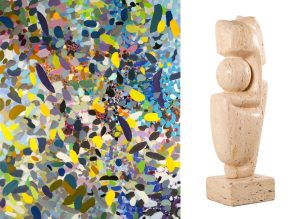
The exhibition also includes works by Palestinian artist Samia Halaby and Jordanian sculptor Mona Saudi (1945–2022). Halaby creates dynamic geometric compositions informed by early Islamic architecture, European avant-garde movements, and the landscapes of Palestine. Meanwhile, Saudi is famous for her stone sculptures that convey vitality, balance, and recurring themes of fertility and growth.
Further highlights include works by Moroccan artist, designer, and educator Mohamed Melehi (1936–2020), Syrian painter Nassir Chaura (1920–1992), Iraqi artist Dia Azzawi, and Egyptian artist, philosopher, and musician Omar El-Nagdi (1931–2019). A founding member of the Casablanca Art School, Melehi is known for his bold, hard-edged compositions and vivid colour palettes inspired by regional crafts and visual traditions.

Chaura, regarded as a leading figure of Syrian Impressionism, moved fluidly between impressionist landscapes and abstraction over the course of his career. Azzawi’s multidisciplinary practice engages deeply with Iraq’s history and cultural memory. El-Nagdi’s work, shaped by Cubism, Expressionism, and Egyptian mural traditions, is particularly recognised for its distinctive calligraphic forms.
Set against a period of political, social, and cultural upheaval across the Middle East and North Africa, The Last Century invites visitors to consider how Arab artists have responded to both local realities and global artistic trends. Together, the pieces on view reveal the diversity, depth, and enduring vitality of Arab art, presenting a dialogue between early pioneers and later innovators who have collectively shaped its visual and intellectual legacy.
To get more information about The Last Century: 100 Years of Arab Art (1920–2020), please go to the official web page of the exhibition.
In addition, you might be interested in attending The Only Way Out Is Through: The Twentieth Line.


