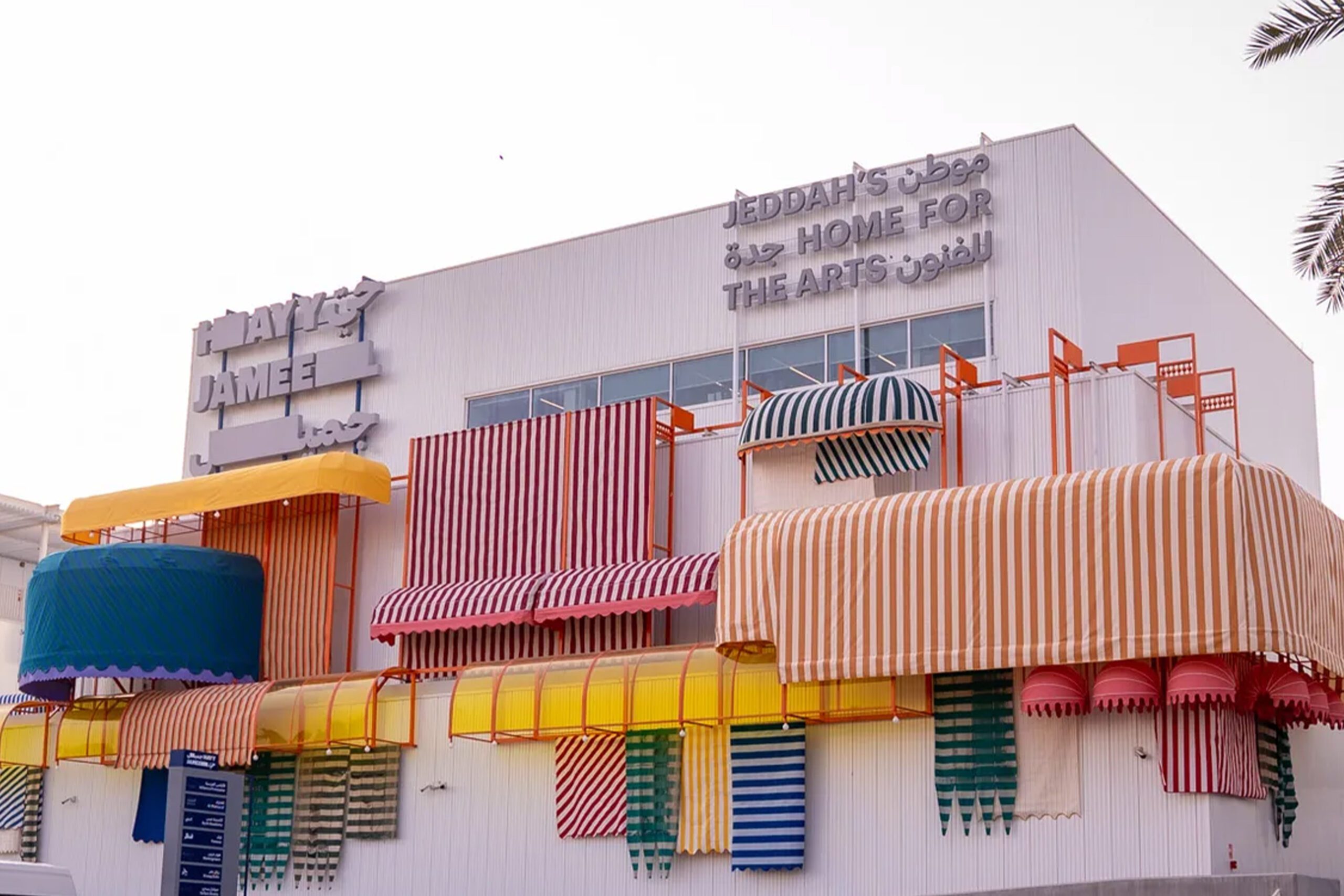
Awnings Awnings Awnings (2026) is the latest Hayy Jameel Façade Commission by the Jeddah-based architecture and research studio Bricklab that transforms the exterior of the cultural centre with an arrangement of striped fabric awnings. Commissioned by Art Jameel, the installation turns an everyday architectural feature into a large-scale public art piece, connecting contemporary cultural space with the visual memory of Jeddah’s commercial streets.
The artwork takes its starting point from the shop awnings that have long characterised historic Jeddah. Attached to storefronts, these structures filter the sunlight, provide shade, extend shops towards the street, and create a transitional zone between the interior and the pavement. Yet their importance extends beyond utility. With their striped fabrics and often vivid, contrasting colours, awnings have become part of the city’s everyday architectural identity.
For Awnings Awnings Awnings, Bricklab takes this familiar typology out of its usual context. Rather than attaching a single canopy to an individual shop, the studio multiplies the form and distributes it across the entire façade of Hayy Jameel. The result is a playful transformation of the building. A succession of projecting elements and colourful textiles interrupts the industrial character of the façade and turns the institution itself into something resembling a monumental commercial frontage. The repetition is central to the work: it echoes the dense visual layering of Jeddah’s streets while shifting an ordinary architectural detail into the realm of public art.

The materials reinforce this relationship with everyday craft and production. The installation combines steel, aluminium, acrylic sheet, fabric, and LED lights. Its fabric components were sourced within Jeddah and produced through existing local networks of suppliers and tailors. This way, the artwork’s material production remains connected to the networks through which such objects have historically been made and circulated in the city.
The emphasis on local fabrication is significant because Awnings Awnings Awnings also reflects on the gradual disappearance of traditional fabric awnings from Jeddah’s streets. As these structures are increasingly replaced by standardised materials such as polycarbonate, some of the texture, colour, and individual variation associated with the older typology is lost. Bricklab’s intervention therefore approaches the awning as both a living architectural element and a form of urban memory. The studio brings it back into contemporary visibility, suggesting that preservation can also take the form of reactivation and reinterpretation.
The commission is particularly appropriate for the Hayy Jameel arts complex, a space for cultural production and exchange in Jeddah. Its façade functions as a 25-metre-wide public “canvas”, and the annual Hayy Jameel Façade Commission invites an artist or collective to develop a major work specifically for this architectural surface. The 2025–2026 open call attracted a substantial number of proposals, and the jury (Dr Effat Abdullah Fadag, Mohamed Almusibli, Nora Razian, and Rayyane Tabet) selected two projects for 2026 and 2027. Bricklab was chosen for the 2026 commission, followed by artist and curator Alaa Tarabzouni for 2027.

About Bricklab
Bricklab was founded in Jeddah in 2015 by brothers Abdulrahman and Turki Gazzaz. They were born and raised in Jeddah, which brings a close understanding of the city’s architectural and urban history to their practice. Abdulrahman studied Architecture and Planning at the University of the West of England in Bristol, while Turki studied Architectural Engineering at McGill University in Montreal.
Their work crosses the boundaries between architecture, art, material research, and urbanism. Bricklab has developed cultural projects, masterplans, public-space interventions, exhibition scenography, and art installations, often using research into the social, economic, and historical contexts of a site as the starting point for design. Their practice particularly focuses on overlooked elements of the built environment and on the relationship between objects, users, and the spaces in which they operate.
The interest in architectural history has also led Abdulrahman and Turki to undertake extensive research into the modernist heritage of Saudi Arabia. Their Saudi Modern initiative examines the country’s architectural transformation. It includes Jeddah’s development between 1938 and 1964, a period of rapid urban and social change that has often received less attention than the city’s much older historical architecture. Bricklab’s broader practice combines design with documentation and historical inquiry, seeking to understand how architecture records changes in society.
This approach is evident in Awnings Awnings Awnings. The installation does not monumentalise a famous building or historical monument; instead, it elevates something ordinary. By enlarging, repeating, and recontextualising the humble shop awning, Bricklab draws attention to an architectural detail that is easy to overlook precisely because it has been such a familiar part of daily life. The colourful façade becomes a reminder that a city’s identity is often constructed not only through its landmarks but through the small, functional objects that shape how streets are inhabited.
In this sense, Awnings Awnings Awnings is both an artwork and an act of architectural remembrance. It brings the textures of Jeddah’s commercial streets into a contemporary cultural setting while allowing the city’s everyday visual language to remain visible, playful, and active. On Hayy Jameel’s façade, the awning symbolises the relationship between architecture, memory, and urban life.
To get more information about Awnings Awnings Awnings, please visit the official website of Hayy Jameel.
You might also be interested in exploring the open-air Sculpture Museum in Jeddah.


