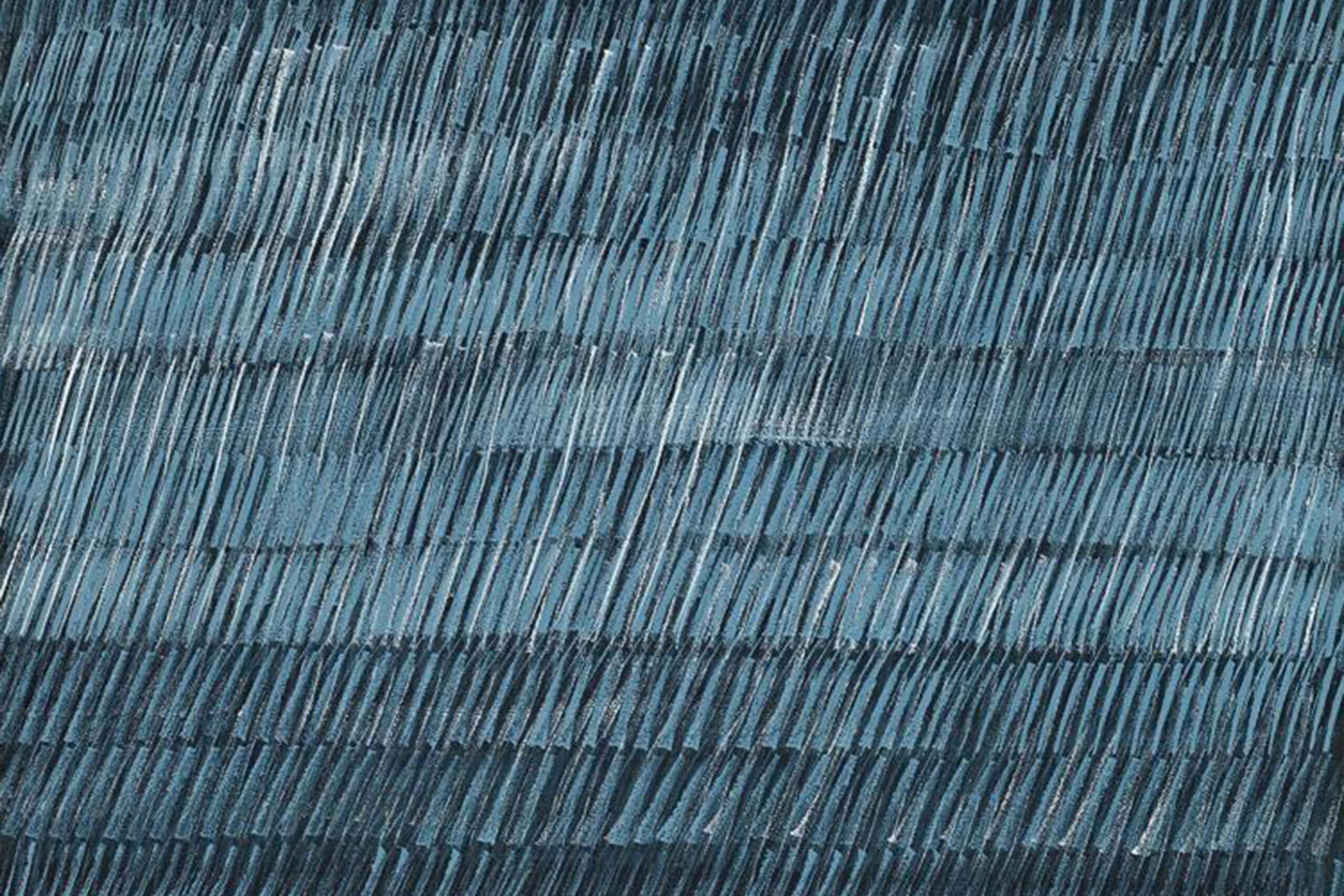
On view at Andakulova Gallery, Fragments of Samarkand is a captivating solo exhibition by acclaimed artist Andrey Krikis (1940–1994), whose practice lies at the intersection of personal recollection and historical imagination. Running through 25 April 2026, the show presents Krikis’s works in which he translates the layered identity of Samarkand into a vibrant visual language.
The artist’s relationship with Samarkand, one of the world’s oldest inhabited cities and a historic crossroads of the Silk Road, is at the heart of the exhibition. Born in Yaroslavl (Russia) and raised in Uzbekistan, Krikis’s early life was shaped by his immersion in the archaeological and architectural richness of the region. His father, an archaeologist working in Samarkand, introduced him to excavation sites and ancient ruins from an early age. These experiences would later inform the symbolic and atmospheric qualities of his work.
Krikis’s artistic development began early. Recognised for his talent as a teenager, he pursued formal training at the Yaroslavl School of Art, where he encountered academic traditions and the radical innovations of modern art. Influenced by figures such as Pablo Picasso, Salvador Dalí, and Joan Miró, he began to experiment with abstraction, colour, and form. Gradually, he moved away from strict realism toward a more expressive and imaginative visual language.

Krikis’s painterly approach is characterised by a bold, intuitive use of colour, so striking that contemporaries referred to him as the king of colour. His artworks often begin with recognisable motifs (architecture, human figures, or a landscape) which are then transformed through abstraction into dynamic, almost dreamlike compositions. This process reflects his artistic philosophy: a desire to move beyond the constraints of academic representation and to capture an emotional and mnemonic essence of place.
An active participant in the Soviet and post-Soviet art scenes, Krikis exhibited widely during his lifetime, with shows across Uzbekistan, Russia, Europe, and beyond. His works are part of museum collections as well as private ones across many countries. Despite this, Samarkand remained the central axis of his artistic universe, a city he returned to repeatedly, both physically and imaginatively.
Krikis’s paintings operate within a space of transformation, where memory and imagination converge. Architectural elements dissolve into rhythmic patterns; figures emerge and recede within fields of pigment; and spatial logic gives way to a more intuitive structure. In this sense, Samarkand becomes less a physical location than a conceptual and emotional landscape.

The notion of fragmentation is central to its conceptual framework. Krikis presents a series of visual fragments, glimpses of a city filtered through memory, time, and subjective experience. It mirrors the way history itself is often encountered: incomplete, layered, and open to interpretation. The art pieces invite viewers to reconstruct their understanding of Samarkand, piecing together visual cues and symbolic references into a personal narrative.
At the same time, Fragments of Samarkand explores cultural continuity and transformation. Samarkand, with its rich tapestry of influences from Persian and Islamic traditions to Soviet modernity, is a potent symbol of cultural hybridity. Krikis’s work captures this complexity, blending historical motifs with contemporary abstraction to create images that feel both rooted and fluid. His artworks animate the past and allow it to evolve and resonate within the present.
This dynamic relationship between past and present is further underscored by the exhibition’s setting in Dubai, a city that itself embodies rapid transformation and cross-cultural exchange. By situating Krikis’s work within this context, Andakulova Gallery creates a dialogue between two geographically distant yet conceptually linked spaces. Both Samarkand and Dubai can be understood as nodes within broader networks of trade, migration, and cultural interaction, albeit in different historical moments.

Importantly, Fragments of Samarkand also highlights the role of individual artistic vision in shaping collective narratives. While Krikis draws on shared cultural heritage, his interpretations remain personal, informed by his own experiences and sensibilities. This tension between the individual and the collective lends the work a universal quality.
In today’s art landscape, often dominated by conceptual frameworks and digital media, Krikis’s commitment to painting as a medium feels deliberate and significant. His artworks emphasise the tactile and material qualities of paint, inviting viewers to engage not only intellectually but also sensorially. Colour, in particular, becomes a vehicle of meaning, capable of conveying emotion, atmosphere, and memory in ways that transcend language.
All in all, Fragments of Samarkand is about evoking a state of mind. It prompts visitors to consider how we remember, how we reconstruct the past, and how cultural identities are formed and transformed over time. Through its rich visual language and layered conceptual approach, the exhibition offers a nuanced and poetic reflection on the enduring power of place, both real and imagined.
To learn more about Fragments of Samarkand, please visit the official website of Andakulova Gallery.
You might also be interested in exploring Picasso, The Figure at Louvre Abu Dhabi and Poetry of Birds at L’ÉCOLE Middle East.