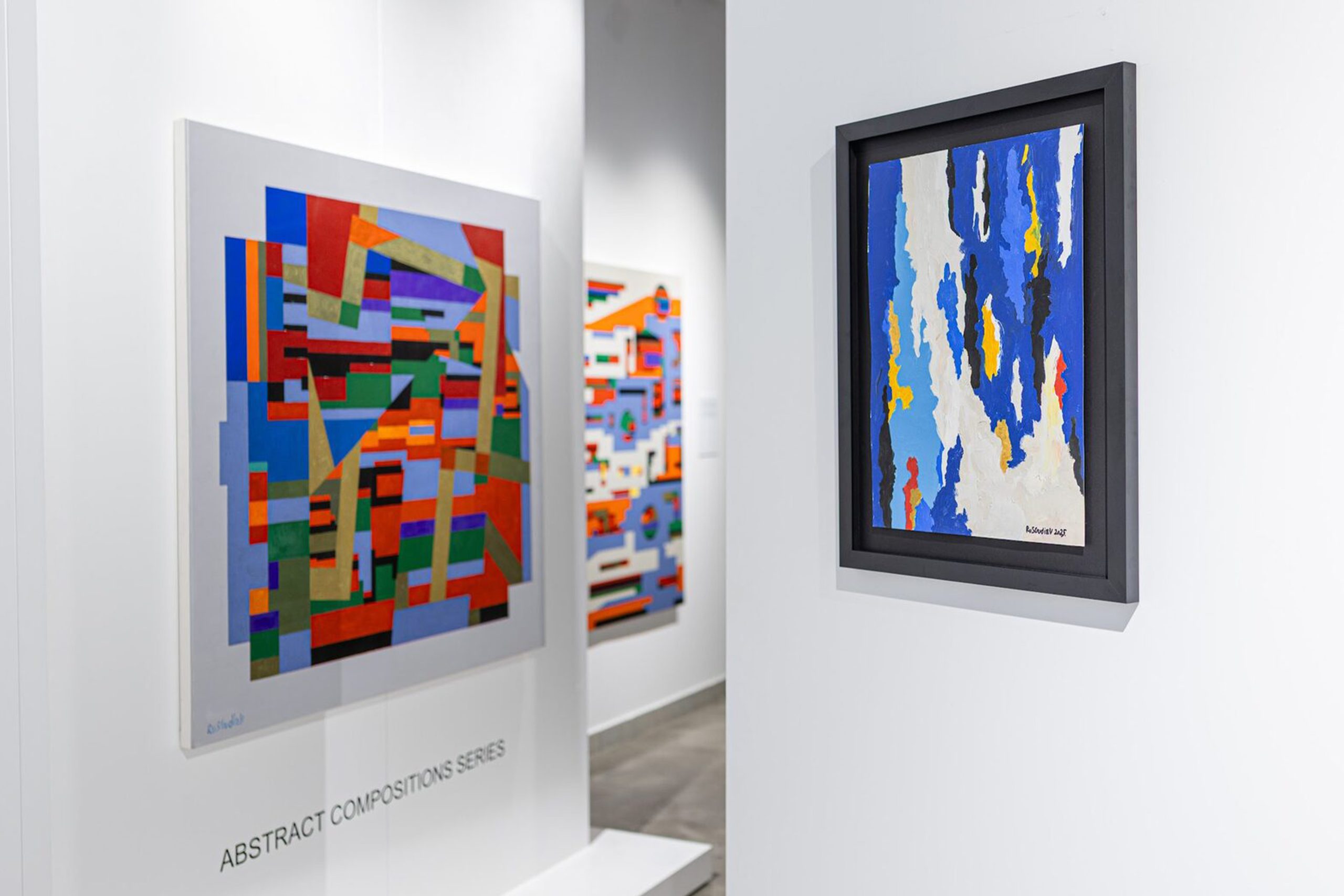
Swiss architect and artist André C. Meyerhans has played a distinctive role in shaping the UAE’s contemporary design landscape through a practice that bridges architecture, design, and visual art. He has consistently explored the relationship between built form and artistic expression, developing projects inspired by the geometry, spatial principles, and cultural heritage of the Middle East while avoiding literal historical imitation.
Among Meyerhans’s best-known UAE projects is his proposal for the New Garhoud Bridge in Dubai. The design, which received a MEED Award in 2010, demonstrated his interest in infrastructure as civic architecture rather than purely functional engineering. His proposal transformed a conventional bridge into an expressive urban landmark with elegant structural forms that reflected both movement and Dubai’s dynamic identity. Although not realised in its original form, the project established Meyerhans as an architect capable of combining technical innovation with sculptural qualities, reinforcing the idea that infrastructure can contribute to the cultural identity of a city.

Meyerhans has also explored urban planning through conceptual residential developments in Abu Dhabi. His project, Al Shamkah Village, proposes a master-planned neighbourhood organised around an orthogonal tessellation with quasi-aperiodic characteristics: an urban structure intended to evoke the organic growth of traditional Middle Eastern settlements. By arranging just six housing typologies in multiple combinations, the design seeks to balance construction efficiency with spatial diversity. It illustrates Meyerhans’s interest in applying geometric principles to contemporary urban planning.
Perhaps Meyerhans’s most visible built work in the UAE is Al Nadi Tower at The Club in Abu Dhabi. Completed to commemorate the institution’s fiftieth anniversary, the tower rises approximately fourteen metres above the breakwater and functions simultaneously as a public artwork, observation platform, and architectural landmark. This sculptural structure is inspired by the motion of a Foucault pendulum, translating scientific principles into architectural form.

Its flowing silhouette is wrapped in a perforated shell that features contemporary interpretations of Islamic geometric patterns. During daylight, the openings frame views of the surrounding waterfront; at night, internal illumination transforms the structure into a glowing beacon visible across the shoreline. Meyerhans created an interactive destination that encourages visitors to ascend the spiral staircase and experience panoramic views over Abu Dhabi, emphasising participation as an essential element of public art.
His long-standing collaboration with the W Abu Dhabi – Yas Island (formerly the Yas Viceroy Hotel) further illustrates the integration of architecture and art within hospitality environments. Meyerhans designed several permanent installations for the property, including the Open Air Majlis, an open-air pavilion overlooking the Formula 1 Yas Marina Circuit that reinterprets the traditional majlis through a contemporary geometric language. Other commissions are large-scale lobby artworks and three-dimensional tile installations that activate circulation spaces while echoing the building’s futuristic architecture. They have become integral elements of the visitor experience and contribute to the spatial identity of one of the most recognisable hotels in Abu Dhabi.

Another important commission is (De)Constructed Culture, created for the Embassy of Switzerland in Abu Dhabi. The installation deconstructs and reassembles traditional Islamic geometric patterns into a series of asymmetrical sculptural forms suspended within the embassy’s public spaces. By translating familiar ornamental systems into contemporary 3D compositions, Meyerhans explores questions of cultural exchange, identity, and abstraction.
The geometric thinking is not just decoration. Meyerhans uses traditional Islamic patterns as a working system: a set of rules for shape, symmetry and proportion that he reworks into new architectural forms. Al Nadi Tower shows this clearly. Its perforated surface is not a decorative skin — it is part of the structure itself, and it also controls light and views. The same thinking connects his bridge design and his housing plans for Al Shamkah Village: geometry, structure and cultural reference are treated as one design problem, not separate layers added on top of each other.
Taken together, André Meyerhans’s contributions to the UAE demonstrate a sustained commitment to expanding the dialogue between architecture and art. Whether designing bridges, observation towers, or public artworks, he seeks to create projects that engage both intellectually and emotionally. His work illustrates how contemporary architecture can draw upon regional culture without relying on historical pastiche, offering instead a design language that is innovative, site-specific, and forward-looking.
About André Meyerhans
Based in Dubai for more than two decades, Meyerhans was born in Switzerland and studied architecture at the Swiss Federal Institute of Technology (ETH Zurich) before completing an MBA at London Business School. Early in his career, he worked with Spanish architect Santiago Calatrava and gained experience in technically ambitious structural design. He later collaborated on retail and brand architecture for international luxury houses, including Cartier, Hugo Boss, and Christian Lacroix, while also participating in major real-estate developments in the Middle East. These diverse experiences helped shape an approach that combines engineering precision with artistic experimentation.

Although his portfolio extends internationally, the United Arab Emirates has become the principal setting for his creative practice. Rather than treating architecture and art as separate disciplines, Meyerhans regards them as parts of a continuous design process. Ideas first explored in paper artworks, furniture, or jewellery frequently evolve into architectural concepts, while architectural research often informs sculptural installations. The fluid exchange between scales allows him to investigate geometry, pattern, structure, and perception in ways that would be difficult within architecture alone. As he explains, artworks become laboratories for architectural thinking, where ideas are tested before being translated into buildings or public spaces.
Across his artistic practice, Meyerhans has investigated the potential of Islamic geometry as a living design vocabulary. His intricate paper cut-outs, sculptural objects, furniture designs, and public installations analyse the mathematical structures underlying traditional patterns while introducing asymmetry, movement, and unexpected spatial relationships. For Meyerhans, geometry is a conceptual system capable of informing architecture, urbanism, and design across multiple scales.
Beyond his architectural and artistic practice, Meyerhans has been recognised as one of the Middle East’s influential architects and regularly participates as a lecturer, critic, and juror at international architecture and design events. His artworks have been exhibited in galleries and design fairs across the region and are held in private collections as well as the Swiss Embassy and royal collections in the Gulf.
To learn more about André Meyerhans’s practice, please visit his official website.
You might also be interested in reading our articles about architectural projects by Zaha Hadid and Norman Foster in the UAE.