Few subjects have captured the attention of artists as fully as the horse. Its beauty lives in the turn of the neck, in the tension of a raised leg, in the moment when weight seems to leave the ground. Grace of this kind exists in motion, and for more than two thousand years artists have tried to capture it in clay, bronze, glaze, stone and paint. The Furusiyya Gallery at Abu Dhabi Royal Equestrian Arts on Jubail Island gathers this centuries-long search for beauty into a single journey. And it does so with an art of display that deserves attention in its own right.
The ADREA campus: an Andalusian town in Abu Dhabi
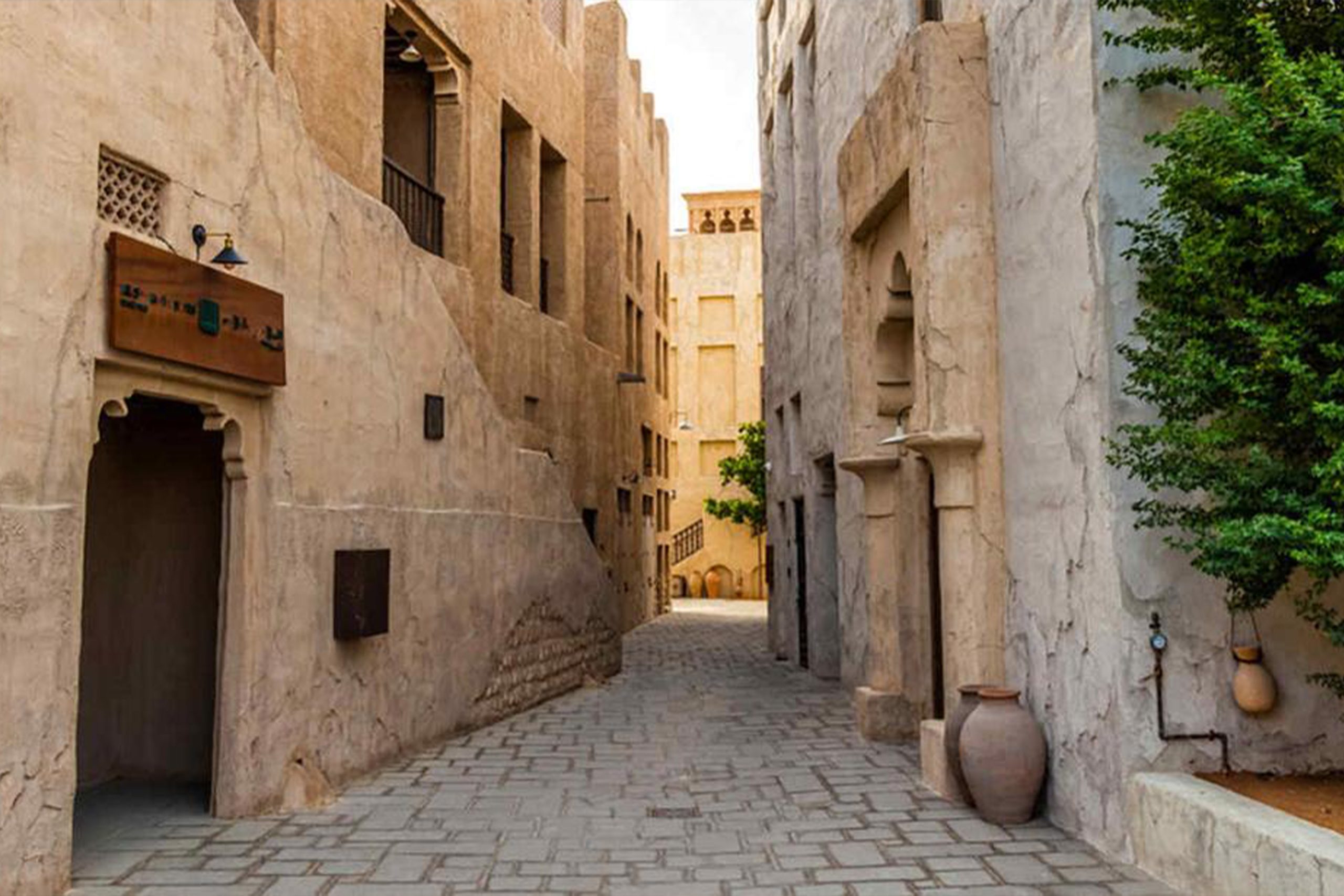
ADREA was inaugurated in autumn 2025 by His Highness Sheikh Mansour bin Zayed Al Nahyan, Vice President, Deputy Prime Minister and Chairman of the Presidential Court. Its 65,000-square-metre campus is conceived as a small Andalusian town among the mangroves of Jubail Island: white arcades with slender columns, shaded galleries, terracotta pavements, olive trees in clay jars beside arched wooden doors. Alongside the Furusiyya Gallery, it is home to the Equestrian Library, with more than 14,000 rare books and manuscripts, the UAE’s first saddle-making atelier, and the Tack Room with an installation depicting the 40 horses of ADREA. Walking through the arcades, the visitor slows down almost without noticing. The architecture sets the rhythm of the visit before the gallery even begins. As Shamma bint Suhail Al Mazrui, Minister of Community Empowerment and Vice Chair of ADREA, put it at the opening: “Horsemanship is deeply woven into our national identity and aesthetic.”

Furusiyya: two thousand years of equestrian tradition
The gallery takes its name from furusiyya, the Arabic tradition of horsemanship rooted in the word faras, horse. Over centuries it came to mean far more than riding, joining skill, discipline, courage and refinement into one ideal. More than 173 rare artefacts and artworks, spanning over two thousand years, trace this ideal from the steppes of Central Asia to the courts of Andalusia. It is one of the world’s largest curated collections, documenting the evolution of equestrian arts across Eastern and Western civilisations and the deep and enduring bond between humans and horses. The horse appears in all its roles: a companion in travel and trade, an ally on the battlefield, a presence in the hunt, a sign of nobility at court. What began as a matter of survival became an expression of mastery, and the horse itself became an emblem of grace, strength and control. Speaking about this heritage, Al Mazrui reminds us where the story begins: “European kings refined it, but the idea began here.”

Some threads run through the whole collection. An eleventh-century incense burner shows movements that riders still practise in the arena today. Other works remind us of women on horseback in earlier eras. The past here does not feel closed; it seems to be waiting for the arena next door.
The collection
The gallery’s collection comes from Shahnaz Gallery, founded by the art historian Bashir Mohamed and now led by Shahnaz Mohamed-Atlas. Bashir Mohamed is a recognised authority on Islamic art: he founded the Islamic department at Spink & Son, served as curator of the Furusiyya Art Foundation and wrote The Arts of the Muslim Knight, published for the exhibition at the Institut du Monde Arabe in Paris.
Each object in the collection is unique and tells its own story. Among the ceramics, two tenth-century bowls from Nishapur, painted in pigments under glaze, draw the eye in particular. One shows a rider with a falcon on a richly saddled horse; the other, a warrior among beasts and mythical creatures, framed by vegetal scrolls and pseudo-Kufic inscriptions. The figure is set within the circle of the bowl, and the composition follows the form of the vessel. Equally impressive is the Tang terracotta A Lady Playing Polo: the sculptor conveys movement through volume, and the horse seems to race at a gallop.

Visitors of all ages are drawn to the Mughal horse armour, or bargustawan, of the seventeenth and eighteenth centuries, made of steel and leather with gilding. It comprises a chamfron, a crinet and plates shielding the chest and flanks. Beside it is the rider’s equipment: a seventeenth-century mail shirt with chest plates, made in Bijapur for the Bikaner armoury, and a Mughal helmet of the same period decorated with gold arabesques.
Formidable in purpose, the weapons are revealed in the display as works of art. A double-ended Mughal spear, which could be thrust or thrown, on foot or on horseback, is overlaid with gold and silver koftgari: its maker made it both effective and visually striking. Just as finely worked is a sword with a gilded hilt and a blade engraved with vegetal ornament; its scabbard bears a coat of arms with a crowned lion.
The art of the exhibition
“Heritage is not a museum that you need to garden — it needs to be lit and burned with a new light,” Shamma Al Mazrui has said of ADREA. In the Furusiyya Gallery, these words can be read almost literally. Light is the true curator of this space. The halls are kept in a soft half-light, and each object receives its own precise beam. The eye moves from one island of light to the next, and every stop becomes an encounter.

Grace in sand
The gallery closes with Before the Grains Could Settle, an installation by Emirati artist Reem Al Mubarak. She collected sand from five terrains across the United Arab Emirates and shaped it into tablets that hold the hoofprints of classical movements: the Spanish Walk, Pirouette, Piaffe and Canter. The tablets rest on a low, flowing base built of fine layers, like strata of sand shaped by the wind.
In the arena, sand is the ground on which every movement is born. Al Mubarak turns that ground into sculpture: after two thousand years of artists representing the horse, she preserves the trace it leaves behind. At this point the gallery’s palette of sand and rose reveals its meaning. The whole space has been leading the visitor towards this material, from the image of the horse to its imprint on the land of the Emirates.
The people behind ADREA
An institution of this kind is the work of many hands, and it deserves to be acknowledged. ADREA exists thanks to the vision of His Highness Sheikh Mansour bin Zayed Al Nahyan and the commitment of the UAE leadership to preserving the nation’s cultural heritage. Its Vice Chair, Shamma bint Suhail Al Mazrui, describes it as “more than a school — it is a bridge between heritage and innovation, a place where tradition breathes and knowledge evolves.” The artistic and technical direction of the school is led by Chief Rider Gonzalo Marques Obeso. Reem Al Mubarak, whose installation closes the gallery, also serves as Head of Culture at ADREA.

The neighbouring spaces continue the same conversation. The Equestrian Library, with more than 14,000 titles, was curated by Isobel Abulhoul, founder of the Emirates Airline Festival of Literature, who says simply: “The ADREA Library is infused with the spirit of horses.” The library and the saddle workshop were designed by the studio David/Nicolas, founded by David Raffoul and Nicolas Moussallem. Their words could describe the gallery as well: “The armour, horse equipment and construction details revealed a strong geometric language where function and beauty coexist.” To all of them, and to the team that brought together and displayed this remarkable collection, we owe an experience that is both scholarly and deeply moving.
A tradition that continues
The visitor leaves the gallery with a sense not of a distant past, but of continuity. The qualities prized by the masters of Nishapur, Tang China and Mughal India — precision, dignity, the harmony of horse and rider — are cultivated today at the ADREA school. A collection built over decades and a young school on Jubail Island speak of the same thing: the culture of horsemanship remains a living part of the heritage of the Emirates, and its story continues to be written here, in Abu Dhabi.
To learn more about Abu Dhabi Royal Equestrian Arts, please visit its official website.
© Julia Smolenkova
© OpenSpace