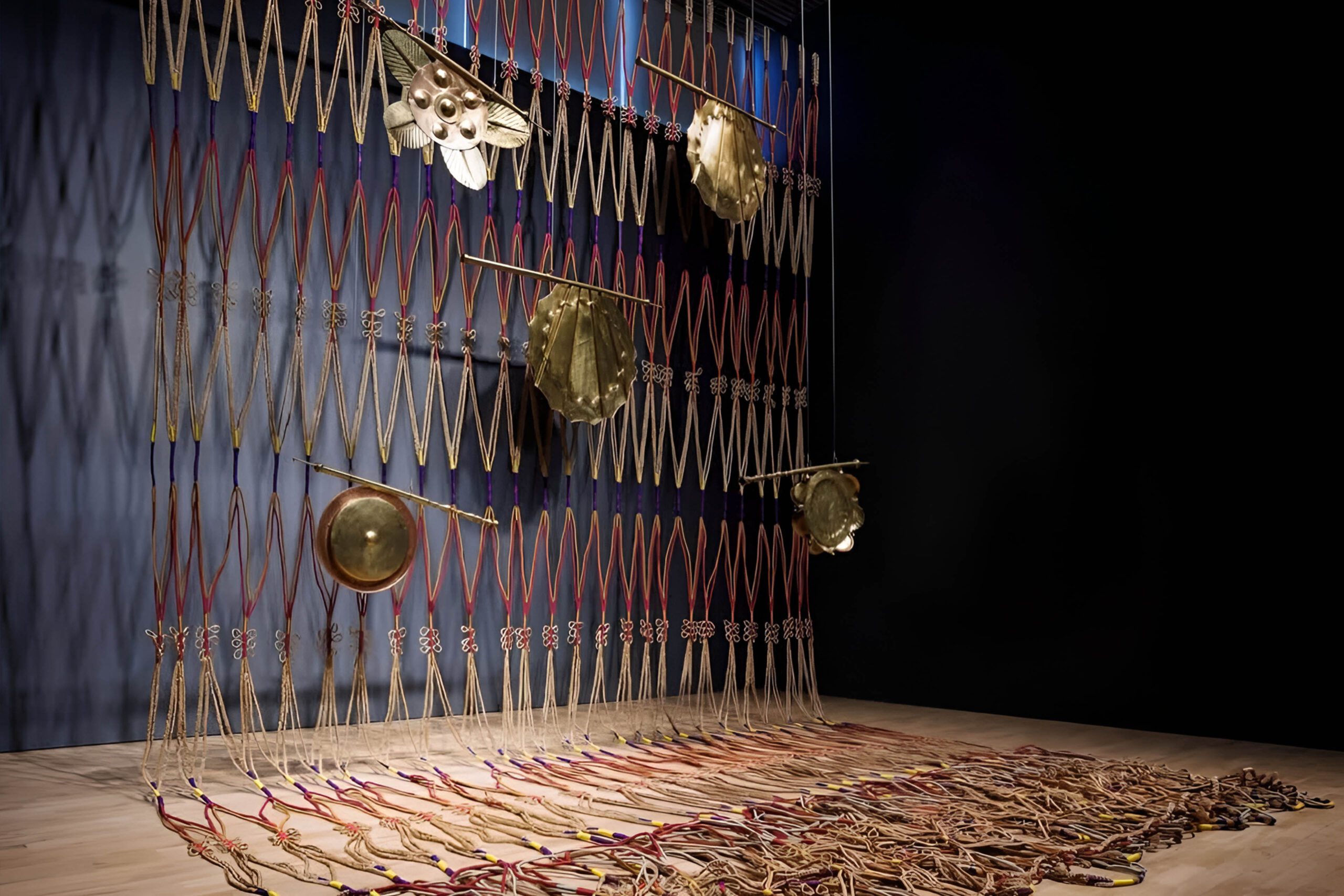
Until 1 November 2026, Jameel Arts Centre is holding Artists’ Rooms: Kamruzzaman Shadhin, an exhibition featuring the Bangladeshi artist’s monumental installation The River Remembers (2023), rooted in the landscapes, histories, and personal memories of Bengal. The show is part of Art Jameel’s Artists’ Rooms series, which presents solo displays developed in dialogue with artists and drawn largely from the Art Jameel Collection. The series places particular emphasis on contemporary practitioners from West and South Asia.
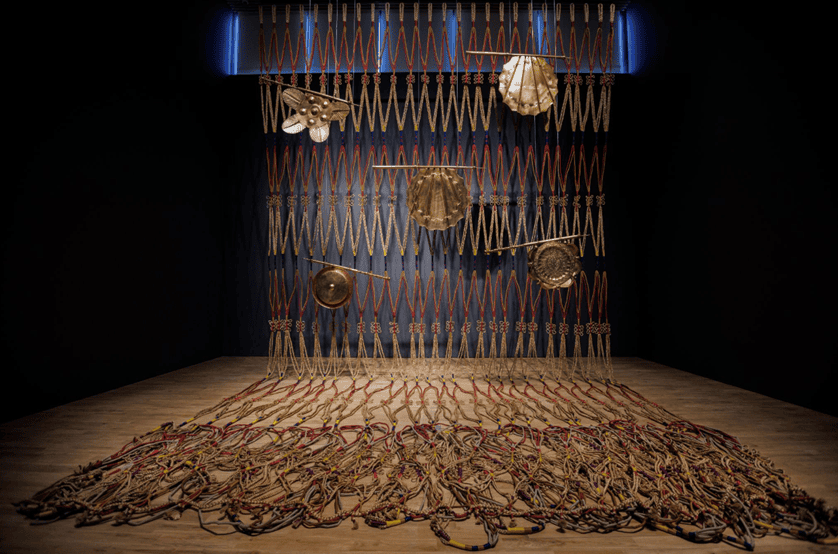
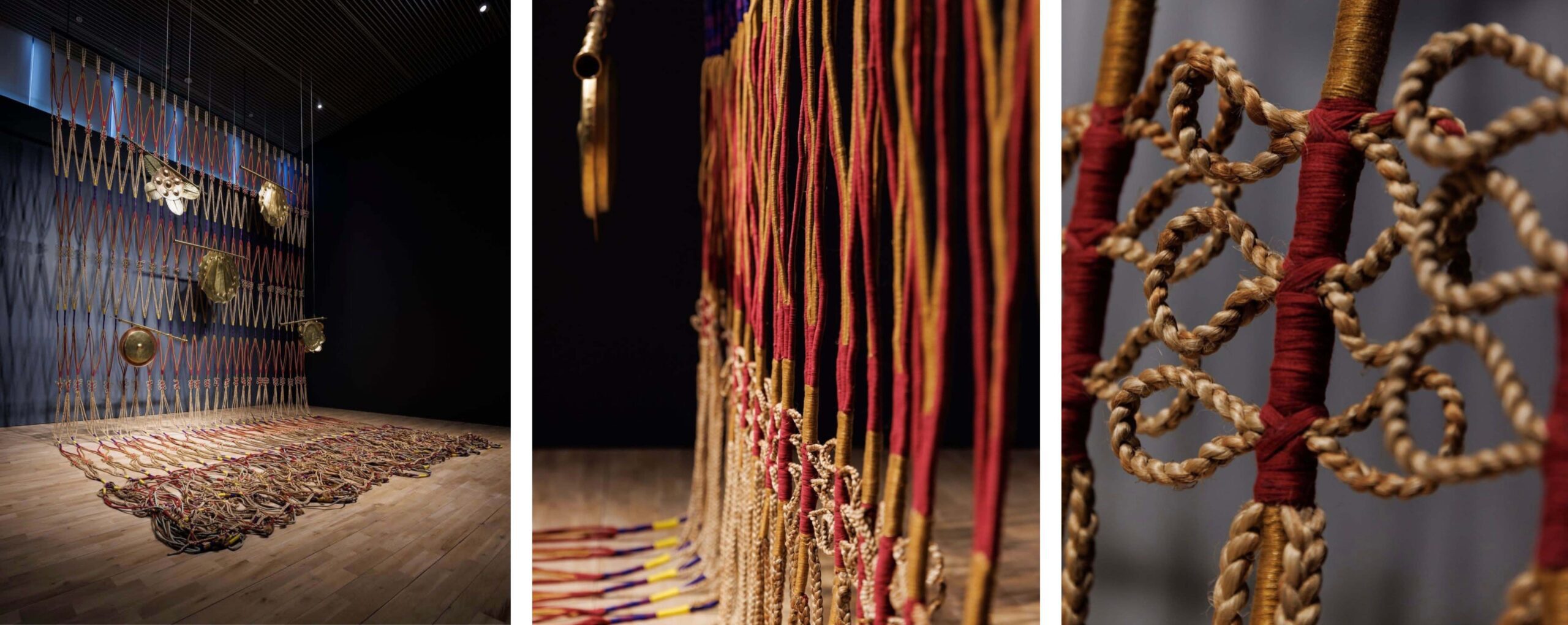
The River Remembers was originally commissioned by the Diriyah Biennale Foundation for the 2023 Islamic Arts Biennale in Jeddah, with additional support from the Samdani Art Foundation. The artwork is made from jute, thread, brass, and copper and takes the form of a large-scale textile landscape. Handcrafted threads trace the colours of the Teesta and Brahmaputra rivers, two major waterways flowing through the Bengal delta.
For Shadhin, these rivers are repositories of memory, connecting individual lives with the wider history of Bengal. Engraved brass discs incorporated into the textile recount the memories and migration stories of two women: Shadhin’s mother and Johura Begum, a traditional jute weaver from his village. Their lives were profoundly affected by the 1947 Partition of Bengal, when the division of British India transformed borders, communities, and patterns of migration across the region.
The personal dimension of the work is particularly significant. Shadhin grew up hearing stories of displacement from his mother, including memories of her childhood home near the Teesta River, which was lost when her family was forced to relocate following Partition. In The River Remembers, these memories are not presented as a conventional family archive. Instead, they become part of a collective visual language in which rivers, materials, and craft practices carry histories from one generation to another.
At Jameel Arts Centre, The River Remembers becomes an immersive environment in which the different strands (personal recollection, migration, ecology, craft, and political history) intersect. The installation’s scale gives the textile an almost cartographic quality, while its handmade construction resists the detached precision usually associated with maps. Instead of fixing a territory through borders and coordinates, Shadhin maps experience: the colour of water, memories of a lost home, the movement of people, and the knowledge preserved through making.
The title The River Remembers consequently works on several levels. Rivers do not possess memory in a literal sense, yet they witness generations of human movement and environmental change. They form borders and pathways, sustain communities, and outlive political divisions. In Shadhin’s installation, the river becomes a means of thinking about how histories survive even when places, borders, and homes have changed.
Presented in Dubai, the artwork also brings a specifically Bangladeshi history into conversation with a broader regional audience. Its story begins with the Teesta and Brahmaputra, but the questions it raises — how migration reshapes memory, how environmental landscapes preserve histories, and how traditional knowledge can enter contemporary art practice — extend beyond any single geography.
About the artist
Kamruzzaman Shadhin (b. 1974, Thakurgaon, Bangladesh) earned a BFA (1996) and an MFA (1999) from the University of Dhaka. He works across installation, performance, video, and public art, developing projects through collaboration with communities and artisans. Themes Shadhin explores include migration, environmental change, history, and the relationship between Bengal’s traditional practices and the region’s political and ecological histories.
A major part of Shadhin’s work is the Gidree Bawlee Foundation of Arts, which he founded in 2001 in Balia, Thakurgaon. The organisation focuses on socially engaged and community-based art, working with local communities and craftspeople. Its projects often use traditional materials and techniques to activate local knowledge and bring overlooked histories into contemporary art.
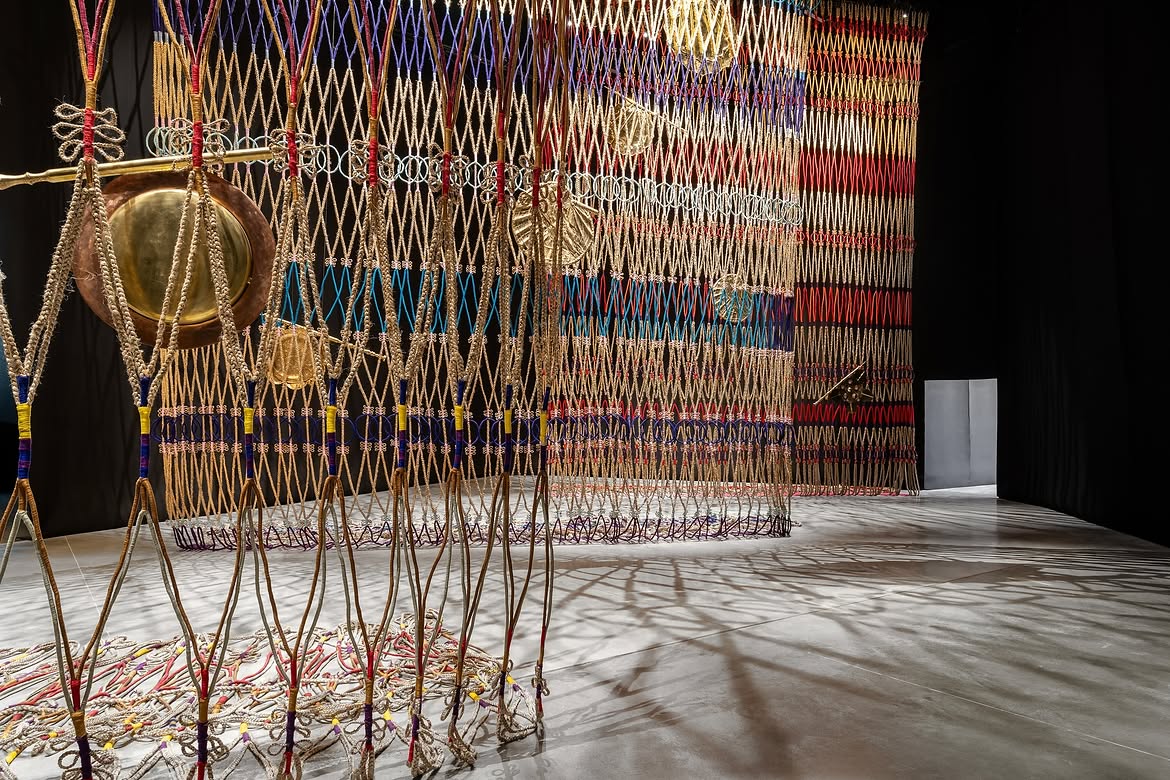
Shadhin’s collaborative method can be seen in The fibrous souls (2018–21), another large-scale installation developed with Gidree Bawlee and communities in northern Bangladesh. The project consists of 70 oversized shikas (traditional jute-string bags) alongside pots and other elements. Created with women from jute-making families, the installation examines histories of migration connected to colonial-era railway infrastructure and the displacement of communities in Bengal.
Jute itself therefore carries particular weight in Shadhin’s work. The plant has long been economically and culturally significant in Bengal, while its cultivation and trade are also inseparable from the region’s colonial history. By using a material associated with everyday life and local craft, Shadhin connects the formal language of contemporary installation with histories that are embedded in objects, labour, and community knowledge.
Shadhin’s art pieces have been featured in many exhibitions and art events, including Dhaka Art Summit (2023); Fabricated Fractures (Concrete, Alserker Avenue, Dubai, 2019); and Rooted in Soi (solo) (Alliance Française de Dhaka, Bangladesh, 2016), among others. He won Honourable Mention Awards at the 16th and 18th iterations of Asian Art Biennale Bangladesh. In 2016, the artist received the Grand Prize at the 17th Asian Art Biennale in Dhaka.
To learn more about Artists’ Rooms: Kamruzzaman Shadhin, please visit the exhibition’s official web page.
While at the Jameel Arts Centre, you might also be interested in exploring Playscape: I Dreamt of a City Everyone Calls Home.
To stay connected with the latest art news, you should follow our Telegram channel.


