In Dubai, there is a parallel city that lives not in postcards with wings and fountains, but in abstract sculptures, strange objects, and quiet gestures in space. These art pieces work slowly, collecting light, air, and the steps of passers-by, and they teach you to look at the city as a living composition rather than a backdrop. In today’s article, we propose a route through nine existing works and one additional sculpture.
The logic of the movement is simple: start in the centre of tourist tension at Dubai Opera, pass through City Walk, drive to industrial Alserkal Avenue, then emerge to the water at Jameel Arts Centre, and finish the day in Expo City, where art is literally built into a mega-event’s infrastructure. It is not a “top 10” for ticking boxes on social media, but a route for those who want to feel how abstraction changes the rhythm of the city and the language it uses to speak to us.
Dubai Opera: Silence at the Epicentre
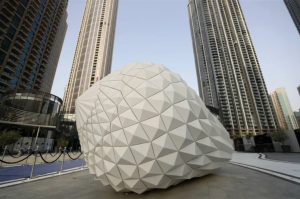
The first stop is easy to miss: in front of Dubai Opera, in the reflections of water and glass, stands Khalvat, a white steel sculpture by Iranian artist Sahand Hesamiyan. The title, which comes from Persian, can be translated as a “secluded, intimate space”, and this is exactly the feeling Hesamiyan carves out of a traditional architectural form, stripping it down to sharp geometry and an inner void.
By day, Khalvat looks almost like an airy model of a dome accidentally left at the foot of a skyscraper. By night, it turns into a steel “cone of light”, a frozen prayer for silence in the noisiest part of the city, where its hollow interior feels more honest than any neon around it. Through its cut‑outs, you can literally “look into” your own sense of privacy while standing in the middle of a tourist cluster.
City Walk: The Word as Space
Declaration by eL Seed, City Walk / Dubai Opera Garden
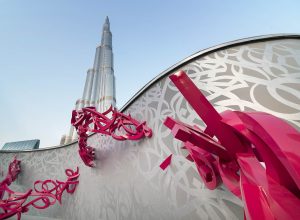
A few minutes’ drive from Opera Plaza is City Walk and the Dubai Opera Garden, where French-Tunisian artist eL Seed’s calligraphic sculpture Declaration stretches a line of Arabic text into a 3D curve. The work quotes a phrase by Sheikh Mohammed bin Rashid about art reflecting people’s culture and history, but the sentence itself breaks down into rhythms, bends, and crossings, losing its literal legibility.
The letters reach into the air as if trying to negotiate with the skyscrapers in their own language, and instead of a “sign”, you get a spatial gesture: the city’s voice cast in metal. What matters here is not the text, but the breath: in daylight, the sculpture feels graphic and strict, at night it turns into a glowing contour whose shadow lies on the paving like a quiet subtitle to the flow of passers-by.
Al Sa’ada by Mattar Bin Lahej, City Walk
Further along the route, the word “happiness” turns into a body. In the sculpture Al Sa’ada, Emirati artist Mattar Bin Lahej breaks the Arabic word into lines and diagonals, pulling the letters into volume and forcing calligraphy to step out of the flat surface into urban space.
From one viewpoint, it is a sharp, almost architectural structure; from another, it becomes a soft handwritten stroke, an accidental note on the margins of the city. Every step around it changes the intonation. In some places, the word comes together, while in others, it nearly falls apart, echoing how fragile and subjective happiness feels in a fast-paced metropolis.
Alserkal Avenue: Industrial Fiction
Deep Earth Object by Mehreen Murtaza, The Yard, Alserkal Avenue
The move to Al Quoz means a change of scenery: low warehouses, ramps, graffiti, trucks, and suddenly the dark sphere of Deep Earth Object by Pakistani artist Mehreen Murtaza, created as a public commission for Art Dubai and Alserkal Avenue. It looks like a meteorite or planetary core that did not fall from the sky but surfaced from the concrete, as if to prove that the city has its own deep geology.
In an industrial yard, this sphere is an obvious outsider, but that very foreignness makes the space more honest: the work’s main theme is how precariously we control material, history and the speed of change. Everything around obeys the logic of logistics and deadlines, while Deep Earth Object introduces another timescale: tectonic, slow, immune to planning.
Street installations and sculptures in Alserkal Avenue
Scattered between white gallery cubes and grey warehouse facades in Alserkal Avenue are other abstract objects, the result of ongoing public commissions and temporary projects. Sometimes it is a hybrid of architectural model and toy, sometimes a fragment of a “broken” city sign, sometimes a piece of minimal geometry leaning against a wall like a part from a pavilion yet to be built.
These sculptures act as punctuation marks in the neighbourhood’s long sentence: commas and colons that make you pause, lift your head and reread your own route. Walking through Alserkal is rarely linear – abstraction here does not illustrate the architecture but keeps nudging you to turn off your path, step into a courtyard, and look at the backstage of the district.
Jaddaf Waterfront: City, Grass, and Reflections
By the water, facing the Downtown skyline, Jaddaf Waterfront Sculpture Park at Jameel Arts Centre offers a completely different tempo: sculptures stand directly on grass and concrete, at the scale of the body rather than the panorama. The park is conceived as an open collection of contemporary art: here you find abstract volumes, fragments of “architecture without a building”, minimal signs and figures whose function is deliberately unclear.
Each piece feels like a found fragment of the future: a shard of a pavilion, an element of some unknown game whose rules no one has written yet. Between them, the city finally stops being a backdrop and starts to act as a partner in conversation: the horizon slides along their clean surfaces, and the water below completes each work with a reflection, turning a solitary sculpture into a doubled, almost cinematic scene.
Expo City Dubai: Time Machines and Beings From the Future
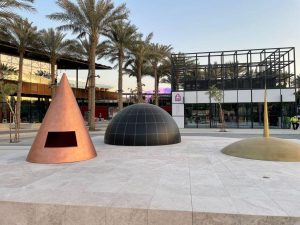
A point in time by Khalil Rabah
In Expo City, where the legacy of the world fair is assembled in pavilions and alleys, Palestinian artist Khalil Rabah’s A point in time turns a scientific instrument into a metaphor of the city. The sculpture is based on enlarged forms of medieval devices for measuring latitude, linking the Expo site to a long history of science and cartography in the region.
On a marble platform, the metal elements arrange themselves like a diagram of time and place: the point on the map literally becomes a “point in time” where routes from different eras intersect. Visually, it reads as a comma in Expo’s vast space, a small pause that reminds you how every mega-project rests on the fragile coordinates of a tiny dot on the globe.
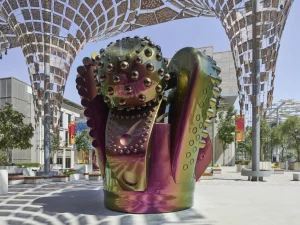
Chimera by Monira Al Qadiri
Nearby, Senegalese-born Kuwaiti artist Monira Al Qadiri’s Chimera continues a conversation about oil, industry and imaginary creatures of the Gulf. The sculpture is based on scaled‑up forms of drill bits once used in sand and sea for oil extraction, but here in Expo, they look like a fantastic organism whose metallic skin shifts colour with the light. At times it resembles a giant sea mollusc, at others a part of an alien spacecraft stuck between landing and take‑off. Around it, Expo’s usual logic falters: it is hard to say whether this is a monument to the fossil‑fuel past or a warning from a future where technology itself becomes a fossil.
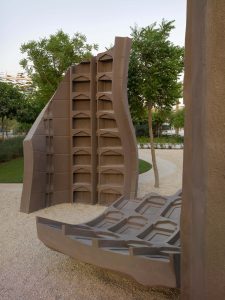
Distorted Familiarities by Asma Belhamar
Emirati artist Asma Belhamar’s sculpture works with the image of the city’s own architecture. Its form looks like a piece of a familiar facade accidentally passed through the filter of a dream: broken planes, shifted perspectives and “fractured” lines clearly echo recognisable silhouettes but never let you grab onto them.
It is an abstraction born of visual overload: a city seen too many times turns into a nervous drawing where floors and windows no longer matter, only rhythm and vibration do. The viewer is confronted not with an “icon” of Dubai, but with its phantom, and in this shift, architecture for the first time becomes a personal experience rather than a marketing picture.
Additional work: Garden by Hamra Abbas, Expo City
In the same Expo City, it is worth seeking out Garden by Pakistani artist Hamra Abbas, a large‑scale marble installation composed of inlaid motifs and ornaments inspired by the history of gardens and decorative traditions, including the Mughal period. Formally, it is not a vertical sculpture but a horizontal abstract “carpet” of stone in which the artist’s personal memories intertwine with historical images of paradise gardens.
Here, abstraction operates through rhythm and repetition: recurring motifs, lines, and colour fields create the sense of a mental garden that you enter not with your body, but with your gaze. In the context of Expo, dominated by vertical pavilions, Garden offers a radically different mode of presence – not reaching upward, but spread along the ground like a quiet map of a wished‑for world.
In addition, you might be interested in reading our articles about other notable public art pieces in Dubai, such as Playscape: I Dreamt of a City Everyone Calls Home and Union of Artists (2024).