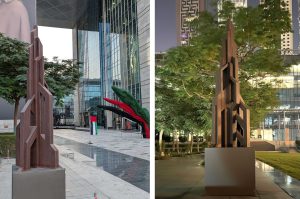
In the contemporary city, public sculpture no longer simply occupies leftover space. It forms visual axes, enters into dialogue with architecture, and becomes part of urban movement. In this context, Guardian Elevation by Swiss artist Xavier Magaldi, presented at DIFC Sculpture Park, appears as a vertical sign and stable landmark within one of Dubai’s densest and most international architectural environments.
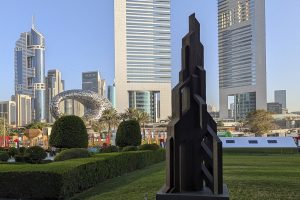
Installed in front of the DIFC Gate, aligned with Emirates Towers and the Museum of the Future, the sculpture is situated at the heart of an emblematic urban scene. It greets visitors and accompanies the daily trajectories of residents and professionals across the esplanade, subtly structuring the space and highlighting the relationship between public art and contemporary architecture. For Magaldi, a public sculpture should not overpower a site but “inhabit it with a clear and benevolent presence,” elevating the cultural dimension of its surroundings.
From Gesture to Volume
Before becoming a monument, sculpture for Magaldi begins with a gesture. His pictorial practice, including early work with graffiti in the urban environment, has long served as a laboratory for exploring form, space, and perception. That early engagement with the street sharpened his awareness of how visual presence interacts with architecture, circulation, and the rhythms of the city.
At the same time, his training in watchmaking brought a distinctly Swiss discipline of precision, proportion, and structural clarity. These two trajectories now converge in his sculptural language, which is marked by controlled precision, assertive geometry, and a composed sobriety where form unfolds with clarity and restraint. Behind this formal rigour lies an intimate quest: the search for an equilibrium capable of withstanding time and the turbulence of the world. In his own words, Magaldi “seeks to materialise time, to transform an invisible dynamic into a stable and legible structure within space.”
Designing with Technology
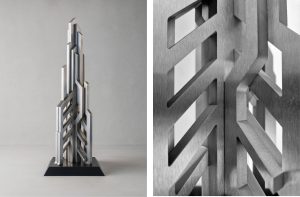
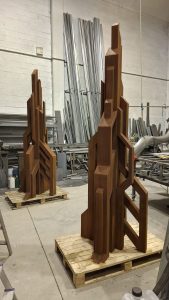
The process begins with hand drawing, where the fundamental lines of the work are traced. It then moves into advanced 3D modelling and simulation, which allows the artist to refine proportions, pursue a precise aesthetic balance, and calibrate volumetric tensions. Digital tools are fully integrated into this methodology. Using augmented reality, the sculpture is virtually projected into its future site, enabling real-scale evaluation, close study of its dialogue with the surrounding architecture, and fine-tuning of spatial relationships before fabrication.
In the Gulf region, where architectural ambition intersects with demanding climatic conditions, this stage becomes crucial. Every detail is conceived to ensure durability, stability, and formal coherence in an environment of heat, wind, and intense light. The moment of installation then marks a shift: the object ceases to be only an artwork and becomes part of the territory, rewriting how the site is experienced and navigated.
Vertical Punctuation in Dubai
The GUARDIAN sculptures are not commemorative monuments and not merely decorative objects. They are conceived as anchoring points able to engage the monumental scale of skyscrapers while remaining legible at human height. In Dubai, a city defined by speed, spectacle, and international flows, this duality acquires particular resonance: the work must offer immediate clarity and a strong visual identity, yet resist the instantaneity of the image.
The elongated geometry of Guardian Elevation acts as a vertical punctuation mark in the urban sentence of DIFC. It proposes an axis, a pause, almost an emotional stabiliser within an environment dominated by motion, acceleration, and constant transformation. In a space where everything is in flux, this insistence on stability becomes a quiet necessity. “Every angle is a decision. Every line is a trajectory,” notes Magaldi.
Each structural element carries multiple directions, like individual life paths converging toward a collective elevation. The form does not impose itself: it invites viewers to stand taller, to realign, to reach toward a sense of surpassing.
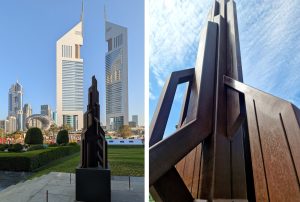
Building with the City
The installation at DIFC confirms a key orientation in Magaldi’s practice: sculpture as a partner to contemporary urbanism. Each GUARDIAN is conceived from the vantage point of surrounding perspectives, the flows of people, and the architectural backdrop into which it is inserted. Rather than competing with buildings, the work establishes a relationship, offering an additional layer through which to read and understand the site.
In an international district where finance, culture, and hospitality intersect, Guardian Elevation operates as a mediating figure: an identifiable presence in a complex and stratified environment. Its verticality and clarity of line provide a kind of visual hinge between scales: from the skyline of towers to the pedestrian level of encounter and contemplation.
An International Grammar of Presence
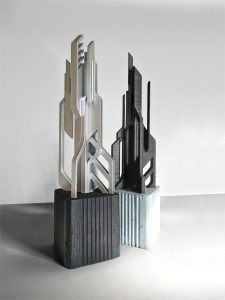
While the DIFC installation marks a significant milestone, it emerges from a broader and coherent corpus. Over several years, Magaldi has developed a series of GUARDIAN sculptures, exhibited in galleries as well as in private and institutional contexts. Works from the series have been installed in southern France, in the sculpture park of Fondation Sigg Art, and in Switzerland, in the municipality of Cologny.
Across geographies, the same core principles persist: verticality, equilibrium, presence, and a quietly benevolent attitude toward space. This is not a proliferation of separate objects, but the unfolding of a continuous language adapted to different sites. Alongside monumental pieces, Magaldi develops smaller-scale sculptures for interior environments, executed in stainless steel, concrete, wood, or via 3D printing. These works preserve the upward tension and structural clarity of the large-scale installations while entering into more intimate relationships with collectors, institutions, or corporate spaces. The scale shifts; the grammar remains.
Toward New Dialogues in the Region
The installation of Guardian Elevation in Dubai opens new dialogues within the Gulf’s evolving cultural landscape. In a part of the world where culture, innovation, and architecture actively reshape the urban fabric, sculpture can accompany this transformation by inscribing a stable yet dynamic artistic presence into rapidly changing territories.
In a city defined by permanent transition, permanence itself becomes a rare value. As part of DIFC Sculpture Park – Edition 4, Guardian Elevation joins around fifty sculptures by 27 international artists presented in collaboration with local and international galleries, installed across the DIFC esplanade until 30 May 2026. Within this constellation of works, Magaldi’s vertical marker proposes not a moment of spectacle, but a sustained pause: a site of orientation, reflection, and quiet elevation in the heart of Dubai.
About the artist
Xavier Magaldi (b. 1975, Geneva) began as a graffiti writer in the late 1980s, developing his style further while painting in cities such as Barcelona. Trained as a watchmaker at the École d’Horlogerie de Genève, Magaldi incorporates technical rigour and a deep understanding of time, movement, and structure into his art. In 2013, he coined the term “MecaFuturism” to describe his distinctive visual language, which combines geometric abstraction with a dynamic, almost mechanical sense of motion. Influenced by Cubism and Futurism, his paintings and sculptures often resemble intricate machines or architectural forms, expressing rhythm, precision, and the materialisation of time through layered lines and interlocking shapes.