
Jameel Arts Centre invites everyone to visit The Peasant, the Scholar and the Engineer, a solo exhibition by Spanish artist and researcher Asunción Molinos Gordo. Marking her first major retrospective in West Asia, it brings together fifteen years of practice dedicated to exploring agriculture, land use, food systems, and heritage. The exhibition will run through 28 September 2025.
At the heart of the exhibition lies Molinos Gordo’s concept of pensamiento campesino (peasant knowledge). This body of wisdom, shaped by generations of small-scale farmers, is reframed as intellectual, ecological, and profoundly relevant to contemporary debates on sustainability, food sovereignty, and environmental justice. The showcased art pieces address themes of water democracy, soil health, and the ways agrarian landscapes embody histories of migration, policy, climate change, and human relationships with the land. Ultimately, the show asks how rural knowledge systems might inspire future models of living.
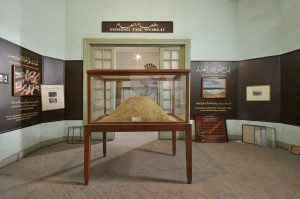
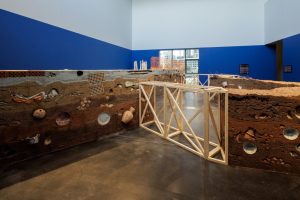
Among the standout exhibits is WAM (World Agriculture Museum), first developed in Cairo in 2010, which presents agricultural tools, techniques, and artefacts as a living archive of farming practices. Another key work, Como Solíamos (As We Used To) (2020), is a rammed-earth installation that echoes the vernacular irrigation systems of Al-Andalus and resonates with the falaj networks of the Arabian Peninsula. It reflects on how land and water management preserve both ecological and cultural memory.
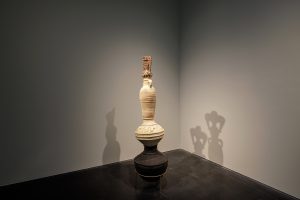
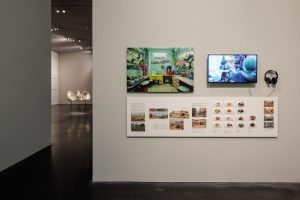
Also on display is Al-Mat’am Elli Mish Masri (The Non-Egyptian Restaurant) (2012), created in Cairo’s Ard El Lewa neighbourhood. The installation functioned as a community eatery where menus combined edible dishes with items crafted from found objects and soil, prompting reflection on Egypt’s food politics. Meanwhile, ¡Cuánto río allá arriba! (How Many Rivers Above!) draws on medieval ceramic traditions from Manises (Spain) to craft stacked vessels that evoke terracotta water containers used across Al-Andalus, Egypt, and the UAE, highlighting water’s enduring cultural and economic value.
About the artist
Asunción Molinos Gordo (b. 1979, Aranda de Duero, Burgos, Spain) studied Fine Arts at the Universidad Complutense de Madrid, where she also earned a Master’s in Contemporary Art Theory and Practice. Her research-driven practice operates at the crossroads of art, anthropology, sociology, and cultural studies.
Molinos Gordo challenges dominant narratives of progress by recognising farmers as scholars, engineers, and custodians of ecological knowledge. Working across installation, sculpture, earthworks, video, sound, and archival research, she frequently collaborates with rural communities to document, reinterpret, and revive practices of irrigation, soil care, seed saving, and land stewardship. Her projects span diverse geographies, from the Arab world and North Africa to Spain’s regions marked by Arab and Muslim heritage.
The artist’s work has been featured internationally in multiple exhibitions, which include Hors Pistes 8th Edition, New ruralities (Pompidou Museum, Málaga, Spain, 2024); the Helsinki Biennial (Finland, 2023); Hunger Machen (solo) (Kunstverein Springhornhof, Neuenkirchen, Germany, 2021); De Campesino a Campesino, XIII Bienal de la Habana (La Construcción de lo Posible, Havana, Cuba, 2019); and Sharjah Biennial 12, The Past, the present and the possible (Sharjah Foundation, Sharjah, 2015).
Molinos Gordo has been recognised with awards, including the ARTSituacions Award (ARCO 2020, Madrid, Spain) and Sharjah Biennial Prize (2015). Her art pieces are part of major collections, such as the Khalid Shoman Foundation (Amman, Jordan), Thyssen-Bornemisza Art Contemporary Foundation (TBA21) (Vienna, Austria), and Crystal Bridges Museum of American Art in Bentonville (Arkansas, USA).
For further details on The Peasant, the Scholar and the Engineer, please visit the official web page of the exhibition.
Additionally, you might be interested in viewing Samur by Zheng Bo and reading our article about three sustainable female designers from the Middle East.


