
Founded in 2002, the Sharjah Calligraphy Museum is the first museum in the region solely dedicated to the art of calligraphy. Located in Bait Hamad Al Madfa at Calligraphy Square in the Heart of Sharjah, the museum offers a chance to admire an extensive collection of Arabic calligraphic works spanning various historical periods, scripts, and styles while exploring the evolution of this timeless art form.
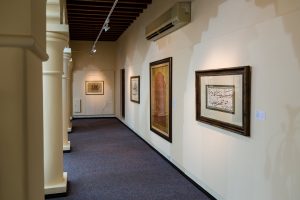
The museum’s collection is divided into four sections. The first one, Historical Calligraphy: Foundations and Customs, delves into the early origins of calligraphy in the Arabian Peninsula, highlighting its foundational principles. Showcasing the peak of calligraphic artistry, the second section, Islamic Calligraphy’s Golden Era, presents intricate and diverse examples from when the art reached new heights of sophistication.
The third section, Area-Specific Styles: A Multifaceted Tapestry, explores different calligraphic scripts that reflect the cultural and linguistic diversity of the Islamic world. A prime example of how cultures are interwoven is the Andalusian script, shaped by the fusion of Islamic and Spanish influences. The last section, Modern Expressions: Exceeding Limits, features contemporary works that push the boundaries of tradition, highlighting the evolution of calligraphy.
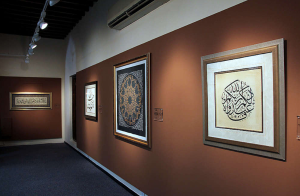
One of the museum’s standout exhibits is a collection of 16 Katateeb Boards gifted by Sudan to the museum in 2006. Traditionally, Katateeb were learning spaces where young people studied the Quran, Islamic teachings, reading, writing, science, and mathematics. Each board on display is inscribed with Quranic verses by students, with two featuring mosque illustrations — signifying the students’ completion of Quranic studies.
The museum also houses three historical paintings in Kufic script, showcasing its evolution across different eras. During the 3rd century AH, the Kufic script, known as Kufic Al Yabis (Stiff Kufic), lacked dots and diacritical marks. The poet Abu al-Aswad Al-Du’ali later introduced a system of large coloured dots above letters in Quranic texts to differentiate consonants. By the 5th century AH, scholars Nasr bin Asim and Yahya bin Ya’amr further developed the system, adding diacritical marks (Ala’ajam) to clarify letters. Finally, grammarian Khalil ibn Ahmad Al-Farahidi refined it further by standardising the marks we use today.
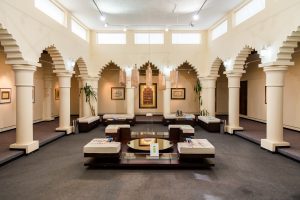
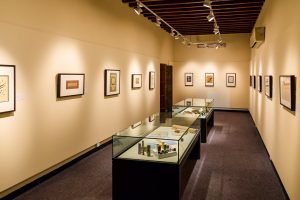
In addition to its artworks, the museum displays essential calligraphy tools like inkpots and pens. A particularly remarkable collection includes 18th-century silver ink pots and boxes for storing writing instruments and ink. These artefacts were generously donated by HH Sheikh Dr. Sultan bin Mohammed Al Qasimi, Supreme Council Member and Ruler of Sharjah.
Beyond its permanent collection, the Sharjah Calligraphy Museum actively promotes and preserves calligraphy through exhibitions, workshops, and conferences. It also features calligraphers’ studios adjacent to the museum, offering visitors an opportunity to witness the creative process firsthand.
The museum is open Saturday to Thursday from 8:00 AM to 8:00 PM, and Friday from 4:00 PM to 8:00 PM. For more details, please visit its official web page.
Additionally, you might be interested in attending the Sharjah Museum of Islamic Civilization and Bait Al Naboodah Museum.


