Not There, Yet Felt is a solo exhibition by Palestinian artist Hazem Harb, currently on view at Tabari Artspace until 27 May 2025. Occupying two gallery spaces, the exhibition presents Harb’s body of work that marks a shift in his practice from collective memory to intimate reflection centred on his childhood home in Gaza.
The show’s title encapsulates the artist’s experience of dislocation: physically removed from Gaza, yet emotionally tethered to its spaces and histories. Harb employs the motif of peeling as a literal and metaphorical device, using photographs of deteriorating walls from his family home to create layered collages. These works reveal layers of colours that speak to decades of lived experience and shifting aesthetics. Mounted on a wall, the collages invite viewers to consider the question: “If these walls could talk, what might they say?”.

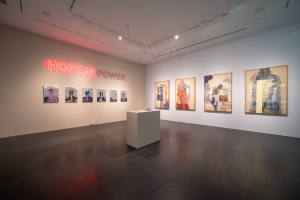
At the heart of the exhibition is Hope is Power, a neon installation where the word “Power” flickers intermittently, symbolising resilience and fragility. This piece is surrounded by four collages on wood that contribute to the narrative of memory and displacement. Also on display is a life-sized self-portrait from Harb’s ongoing Gauze series; this piece encapsulates a sense of dislocation and personal vulnerability. The artist’s choice of material, gauze, is fragile and protective and evokes the tension between healing and pain and the notion of repair.
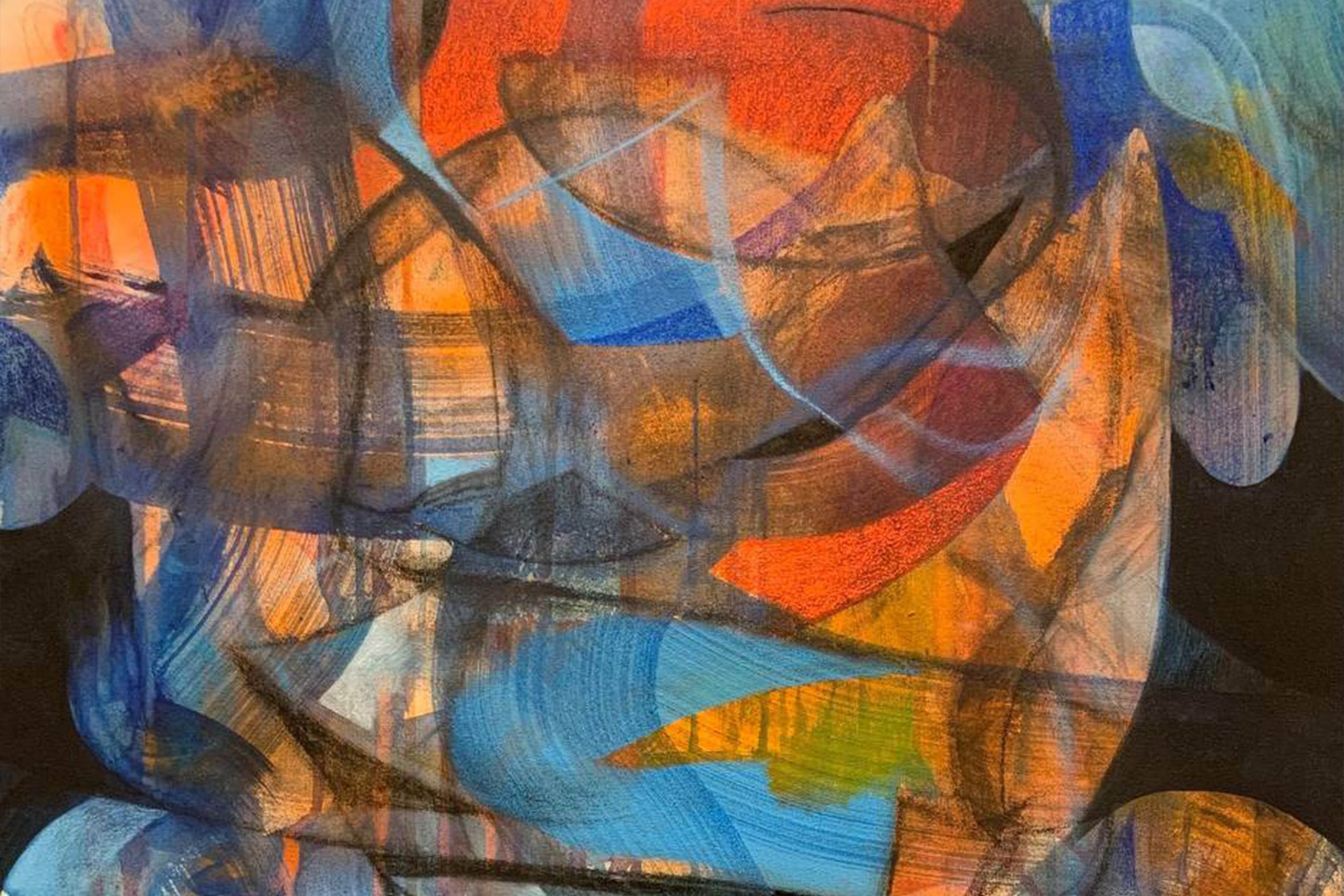
The second gallery space houses Harb’s works produced 20 years ago while he was a student in Italy, newly displaced from Gaza. These early mixed-media pieces, rendered on coarse hessian, feature abstracted figurative forms in different states of emergence and erosion. Now, exhibited alongside his recent artworks, they acquire a renewed intensity as if the present has peeled back to reveal the outlines of an earlier self.

The exhibition is accompanied by Harb’s poem On the Edge of Forgetting, which focuses on memory, absence, and the enduring connection to home. The poem serves as a personal reflection and an invitation for visitors to engage with the layered narratives presented throughout the exhibition.
About the artist
Hazem Harb (b. 1980, Gaza), a multidisciplinary artist whose practice spans drawing, painting, graphic design, video, sculpture, and installation, lives and works between Rome (Italy) and Dubai. Harb studied Visual Art at the Academy of Fine Arts in Rome and earned an MFA from the European Institute of Design in 2009.
His work addresses themes of war, displacement, trauma, human fragility, and global instability. Through a nuanced exploration of the relationship between people and place, Harb investigates how architecture and landscape shape lived experience. He frequently works with archival materials (photographs, negatives, and maps) to produce collages that surface suppressed narratives and prompt historical reconsideration.
Harb’s creations have been exhibited internationally, with presentations including Global(e) Resistance (Centre Pompidou, Paris, France, 2020-21); Power Does Not Defeat Memory (solo) (Sabsay Gallery, Copenhagen, Denmark, 2019); the 57th Biennale di Venezia (Venice, Italy, 2017); Present Future (Artissima, Italy, 2014); and the 15th Fotofest Houston International Biennial of Photography and photo-related Art (Houston, Texas, USA, 2014), among others.

His accolades include artist residencies at the Cité des Arts (Paris, 2013), Satellite (Dubai, 2012), and the Delfina Foundation (London, 2011), to name a few. In 2008, he was shortlisted for the A.M. Qattan Foundation’s Young Artist of the Year Award. Harb’s works are in prestigious international collections, such as the British Museum (London), LACMA (Los Angeles, USA), and the Centre Pompidou (Paris).
To learn more about Not There, Yet Felt, please visit the exhibition’s official web page.
You might also be interested in attending Lines of Flight by Shilpa Gupta and Unraveling by Huda Lutfi.