
Maraya Art Centre is currently home to Nadia Saikali and Her Contemporaries, an exhibition co-organised with the Barjeel Art Foundation, running through 13 July 2025. The show centres on renowned Lebanese painter Nadia Saikali’s abstract painting practice while contextualising it within a wider circle of female abstractionists in Beirut and across the Arab world during the 1960s–80s. Curated by Suheyla Takesh and Rémi Homs, curators at Barjeel, the exhibition reclaims a vital yet often overlooked chapter in regional art history.
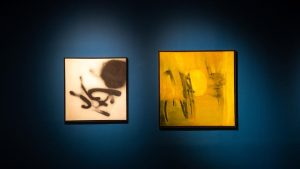
Exhibited are about 55 artworks from Barjeel’s collection, supplemented by art pieces from Dubai’s Habbal Collection. Saikali’s canvases are displayed chronologically, tracing the evolution of her formal language over six decades. Viewers journey from her early 1960s gestural experiments in works like Gesture and Bull, to the structured geometries of the 1970s exemplified by Vertical Rhythm, and into the 1980s with textured abstractions such as Empreinte Autoportrait Ile Sanctuaire, where handprints and footprints ripple through fields of blue.
Accompanying these works are archival materials (photographs, personal notes, and press clippings) that add a biographical layer to her story and reveal Saikali not only as a painter but also as a thinker, performer, and innovator.
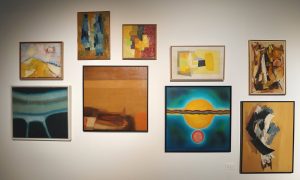
The exhibition extends its narrative through art pieces by Saikali’s celebrated contemporaries in Lebanon, including Saloua Raouda Choucair (1916-2017), a pioneer in Arab abstraction; Huguette Caland (1931-2019), known for her sensuous forms and playful line; Etel Adnan (1925-2021), renowned for her luminous, abstract landscapes; and Helen Khal (1923-2009), whose expressive colour fields brought emotional nuance to geometric form.
Also on view are works by artists from across the region whose paths intersected with Beirut through education, exile, or creative exchange. These include Saudi-Kuwaiti artist Munira Al‑Kazi (b. 1939), Madiha Umar (1908-2005), Jordanian sculptor Mona Saudi (1945-2022), Syrian painter Asma Fayoumi (b. 1943), and Palestinian artist Maliheh Afnan (1935-2016), among others. Together, their practices underscore Beirut’s role as a key hub for modernist abstraction in the Arab world.
About Nadia Saikali
Nadia Saikali (b. 1936, Beirut) is a pivotal figure in Arab abstract art. She studied at the Lebanese Academy of Fine Arts (ALBA) in Beirut before continuing her training in Paris at the Académie de la Grande Chaumière and École des Arts Décoratifs. There, she worked in the studios of Henri Goetz, Michel Durand, and Donnot Seydoux. Saikali returned to Beirut in the mid-1950s and later settled in France in 1979 during the Lebanese Civil War.
Her art draws from a range of disciplines, such as astronomy, geology, spirituality, philosophy, and even her background in ballet, all of which infuse her compositions with lyrical movement and meditative intensity. Whether painting on the floor or upright against a wall, Saikali constructs vivid volumes of colour and light with a gestural energy that is at once personal and cosmic.
Her work has been featured in multiple exhibitions, including the Salon du Printemps (UNESCO Palace, Beirut), the São Paulo Biennale (Brazil, 1967), and Salon d’Automne (Sursock Museum, Beirut). Her paintings are part of prominent collections: the National Fund of Contemporary Art (Paris), the Society of Lebanese Architects and Engineers (Beirut), and the Royal Institute Galleries (London, UK), to name a few.
To learn more about Nadia Saikali and Her Contemporaries, please visit the exhibition’s official web page.
You may also be interested in viewing Fahrelnissa and the Institutes: Towards a Sky, one of the online exhibitions at the Cultural Foundation.
To stay updated with the latest art news, you can join our Telegram channel.


