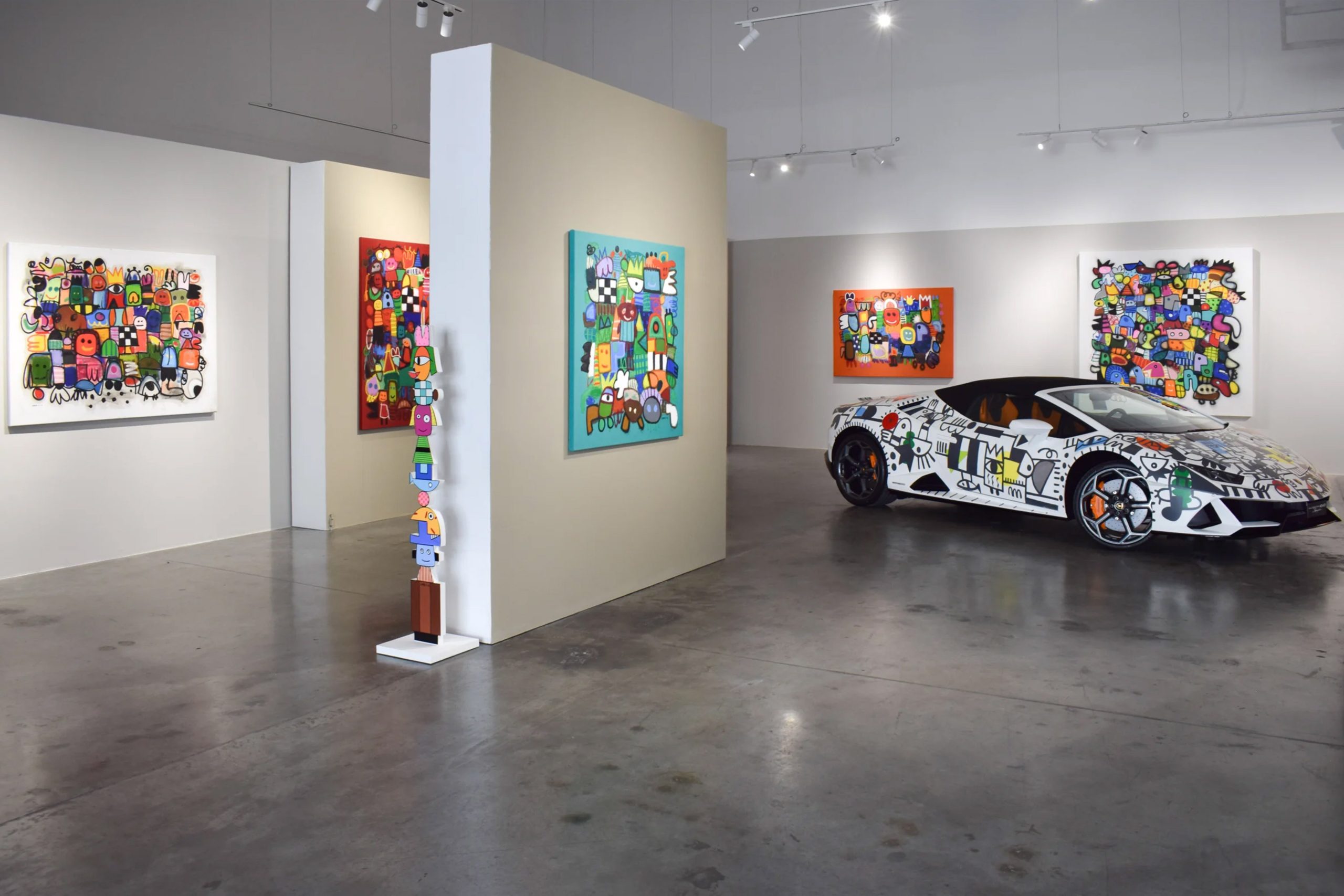
Dubai’s financial district art cluster today is a self‑contained cultural itinerary that can be easily explored in a single evening without ever leaving DIFC. The area around Gate Village and Gate Avenue is now a dense network of spaces where global blue‑chip art, regional contemporary practices, and an open‑air sculpture park function as a single stage.
Perrotin: global contemporary among the towers
The French gallery Perrotin in Gate Village 5 has become one of the key symbols of how Dubai has inscribed itself onto the global art‑market map. The podium‑level space presents artists such as Daniel Arsham, Yayoi Kusama, and other stars from the gallery’s roster, offering visitors the kind of “global contemporary” they would normally encounter in Paris, New York, or Hong Kong.
The gallery’s opening hours are aligned with the rhythm of the financial centre. It is convenient to drop in after work or between meetings, which subtly changes the habit of gallery‑going, turning a “museum trip” into a short but regular stop within a single district. For collectors, Perrotin in DIFC is an accessible contact point with the gallery’s global programme, a place to view, discuss, and reserve works in a calm, almost office‑like atmosphere.

Opera Gallery: between modernism and a vivid market
Opera Gallery Dubai in Gate Village 3 operates at the intersection of contemporary and modern art, combining Western masters with names that resonate strongly with regional audiences. It is a place where painting and sculpture are clearly oriented towards visual impact and collectability, consciously calibrated to the expectations of DIFC clients.
Unlike more conceptually driven spaces, Opera Gallery prioritises spectacle and a strong visual language that works equally well in private interiors and corporate environments. For anyone studying the market, this is where one can clearly observe how regional tastes are evolving, from cautious interest in canonical names to increasingly bold demands for contemporary work.

Sconci Gallery: an Italian trace in Dubai
Sconci Gallery in Gate Village extends an Italian gallery tradition into the context of the UAE. Its programme includes post‑war and contemporary painting and sculpture, featuring European artists whose language is familiar to seasoned collectors as well as those seeking a “classical” visual idiom in up‑to‑date form.
Beyond exhibitions, Sconci actively uses the space for intimate events: private views, artist talks, and presentations that bring the gallery closer to a club‑like format and foster long‑term relationships with its audience. For DIFC, this model feels organic: people here value both art and the opportunity to interact in a small yet professional circle.
Christie’s Gallery: the auction house as an open showcase
The Christie’s Gallery at DIFC operates as a public front‑of‑house for one of the world’s leading auction houses. It hosts previews for sales in London and New York, as well as thematic exhibitions and anniversary projects. In 2025, for instance, the space marked 20 years of Christie’s in the region with the programme “20 years of connecting global art with regional communities.”
What makes the gallery distinctive is its focus not only on established collectors but also on a wider audience who come to DIFC for work and, in the process, find themselves inside a global art context. As a result, the auction house ceases to function as a closed club and becomes part of the district’s everyday cultural infrastructure.

Andakulova Gallery and other DIFC points
Slightly away from Gate Village but still within DIFC, Andakulova Gallery focuses on contemporary art from Central Asia. Located in Damac Park Towers, it brings an important regional emphasis to the district, showing artists who are rarely visible in classical Western institutions but are crucial for a broader Eurasian perspective.
Alongside major names such as Perrotin, Opera Gallery and Christie’s, these more niche spaces provide a necessary balance: this is where a dialogue emerges between the global canon and alternative centres of meaning‑making. For visitors, it offers a chance to encounter global brands, regional narratives, and new voices along a single route, without leaving the financial quarter.

The sculpture park as a shared stage
Another layer of DIFC is the DIFC Sculpture Park, an open‑air sculpture project whose fourth edition brings together around 50 works by 27 artists from 13 countries. The route stretches from Gate Building to Gate Avenue, turning the daily flow of office workers and visitors into a continuous, if discreet, conversation with art.
The park ties the individual galleries into a single system. A visitor can step out of Perrotin or Opera Gallery and continue the “exhibition” outdoors, without switching from a contemplative mode into a transport mode. It is precisely this continuity – from white cube to the street – that makes DIFC one of the most compelling examples of how a financial cluster can evolve into a fully fledged cultural district.
In addition, you might be interested in visiting the Special Olympics Garden at Manarat al Saadiyat and the open-air Sculpture Museum in Jeddah.
To stay connected with the latest art news, feel free to follow our Telegram channel.