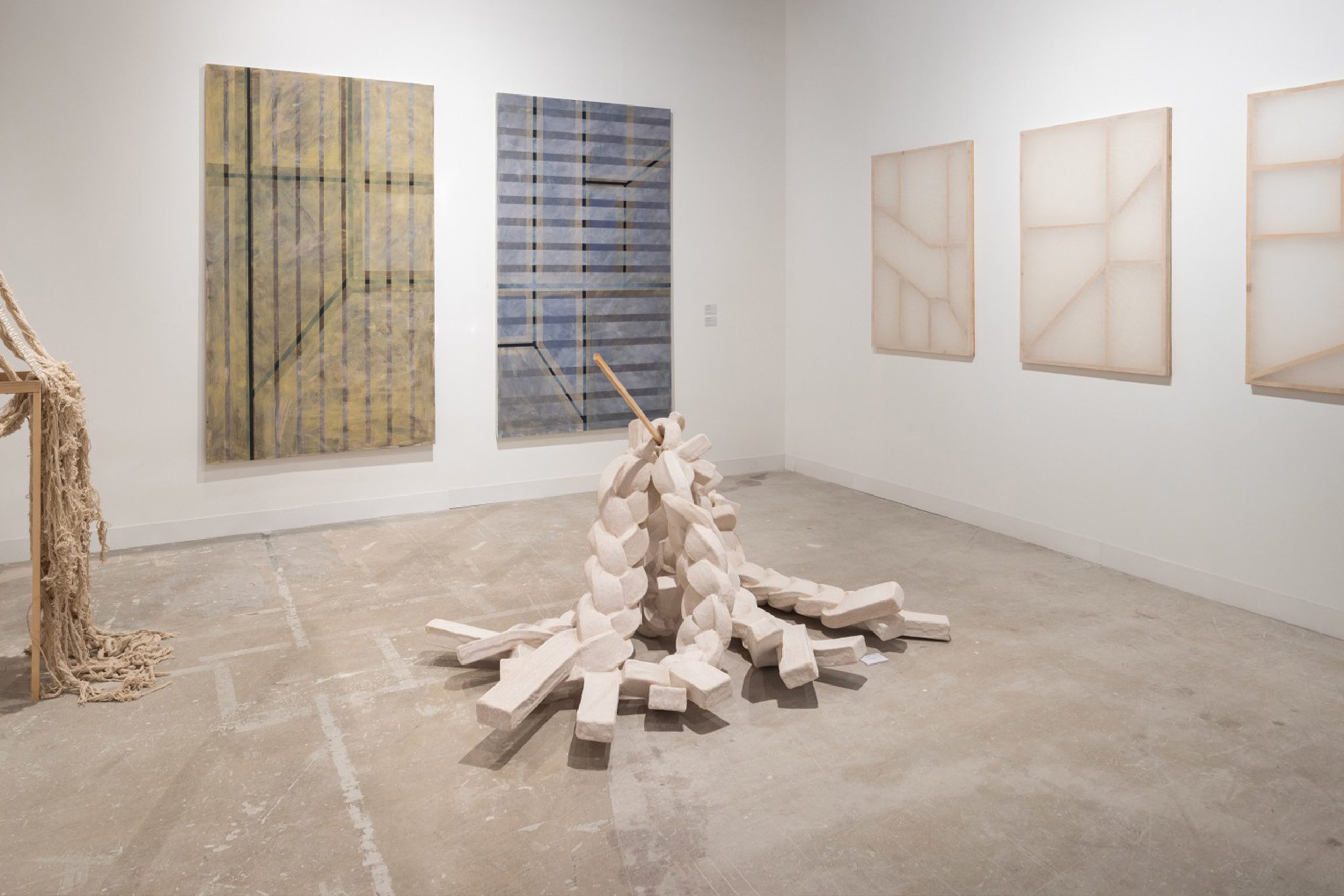
Mamluks: Legacy of an Empire at Louvre Abu Dhabi, on view until 25 January 2026, takes one on an immersive journey into the history, culture, and artistic brilliance of one of the most powerful and influential dynasties of the medieval Islamic world. Curated by Dr Souraya Noujaim and Dr Carine Juvin with the support of Fakhera Alkindi, this landmark exhibition is presented in partnership with the Musée du Louvre and France Muséums.
The Mamluk Sultanate spanned more than two and a half centuries of rule (1250–1517). It dominated Egypt, the Levant, parts of Anatolia, and the Arabian Hejaz, becoming a nexus of political power, trade, cultural exchange, and artistic production. Far from being remembered solely as formidable warriors, the Mamluks emerge in this exhibition as master craftsmen, skilled diplomats, and key participants in global interactions that shaped the late medieval world.
Organised into seven thematic sections, the display traces the social structures, cultural connections, and far-reaching influences of the Sultanate, including its role in global trade networks linking Asia, Africa, and Europe. Visitors are welcome to admire about 270 exceptional objects, drawn from over three dozen institutions across the globe, from the King Faisal Centre for Research and Islamic Studies (Riyadh, KSA) to the British Museum.
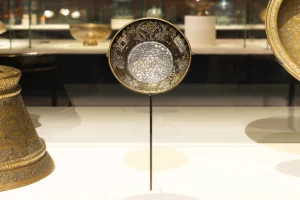
Among the exhibits are calligraphy and refined arabesque designs, textiles and ceramics, intricately worked metal pieces, rare manuscripts, coins, and other artefacts that reveal the extraordinary creativity and cosmopolitan vision of Mamluk society. The iconic masterpieces on view include the celebrated Basin, known as the Baptistery of Saint Louis, on loan from Musée du Louvre. It is a 14th-century inlaid metal basin whose ornate scenes reflect artistic daring and the enduring circulation of objects across cultures long after the empire’s end.
Also displayed is Carpet Decorated with Three Medallions, a piece from Louvre Abu Dhabi’s collection. Crafted in the renowned workshops of Cairo in the second half of the 15th century, this ceremonial carpet features three central medallions framed by an intricate border. Its design showcases geometric patterns and stylised plant motifs, elements often seen in architectural embellishments and illuminated manuscripts of the era.
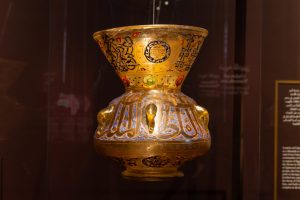
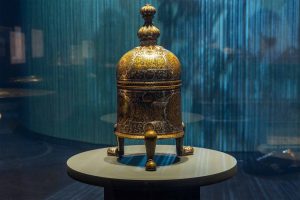
Other outstanding loans are a Certificate of Pilgrimage (Hajj) issued in 1433 to Maymuna, daughter of Muhammad al-Zardili, on loan from the British Library; an incense burner inscribed with the name of Sultan al-Nasir Muhammad ibn Qalawun (c. 1330–1341) from the Museum of Islamic Art (MIA) in Doha; and a Mosque Lamp bearing the name of Emir Qawsun (c. 1330–1335), lent by the Metropolitan Museum of Art (The Met) in New York.
Notably, the exhibition uses modern technology to enhance the visitor experience. Five interactive screens placed throughout the galleries allow guests to explore the stories behind each art piece with immersive visuals and sound.
To get more information about Mamluks: Legacy of an Empire, please go to the official web page of the exhibition.
Additionally, you might be interested in visiting MIA, where you can have a look at the splendid Damascus Room and the Varanasi-style necklace.
To stay connected with the latest art news, feel free to follow our Telegram channel.